

Partner, Kingsley Szamet Employment Lawyers · California State Bar, Admitted 1996
Experience
29 Years
Recovered
$300M+
Class Actions
150+
If you were fired unfairly, you may be wondering if you have a claim and what the value of your case is. My team and I have created our wrongful termination settlement calculator to help victims get a fast initial estimate. If you believe you have been unjustly fired or forced to leave due to unsafe or hostile conditions, you have the legal right to seek compensation from your former employer.
Wrongful Termination Calculator
Although an accurate wrongful termination calculator does not exist, it may be possible to determine the damages and review previous cases that can give you an idea of how much you should receive.
I've been doing this for 29 years, and my advice to victims is always the same. Schedule a free consultation and speak with an experienced wrongful termination attorney who understands your rights as an employee and the responsibilities of employers. There is no replacement for this step. Familiarizing yourself with these basic principles will help you navigate the process effectively and ensure that you receive fair restitution for any wrongdoing.
Table of Contents:
- Calculating Damages in Wrongful Termination Cases
- Legal Assistance for Wrongful Termination Claims in California
- Types of Compensation Available in Wrongful Termination Lawsuits
- Proving Wrongful Termination in California
- The Role of Punitive Damages in Settlement Calculations
- Frequently Asked Questions
- Know Your Rights, Know What You're Worth
Calculating Damages in Wrongful Termination Cases

After you've been wrongfully terminated, you're dealing with more than just the shock of losing your job and livelihood. You're dealing with unpaid bills, and wondering how you'll cover rent this months rent.
That's where damages come in.
In my experience, I usually expect to see California wrongful termination settlements fall between $40,000 and $120,000 depending on the details of the claim. But I've seen cases go much higher depending on what happened and how it affected you. The specifics matter a lot.
Lost Wages and Future Earnings
Lost wages are straightforward, it's the money you would've earned if you hadn't been illegally fired. We calculate every paycheck you missed from the day of termination until we settle your case or win at trial. The formula looks like this
Economic Damages = [Total Yearly Compensation] X [Number of Years Unemployed]
But future earnings? That's where things get interesting.
If you were on track for a promotion, on track for a big bonus, lost out on commissions, or maybe lost your stock options. Those lost opportunities have real dollar value. The higher your salary was, the more you stand to recover.
My Opinion: The Lost Wages Formula Is Just the Starting Point
People often fixate on the basic lost wages number, and I understand why, it's concrete, it's calculable, it feels like solid ground. But in my experience, that figure is the floor, not the ceiling. The cases that result in the highest recoveries are the ones where we dig into everything the client lost: the bonus they were about to receive, the stock options that were weeks away from vesting, the promotion that was verbally promised. I've had clients initially estimate their damages at $50,000 who walked away with multiples of that once we accounted for the full picture. Don't sell yourself short before you've spoken to an attorney.
Non-Economic Damages and Their Valuation
Now let's talk about a more difficult topic, non-economic damages. Non-economic damages are intangible harms that might include feelings such as emotional distress, depression, or panic attacks for example. If you've needed therapy or medication because of what your employer put you through, that counts.
Medical expenses tied to this stress add up fast. And if your employer's behavior was particularly cruel or outrageous, punitive damages might be on the table too.
In my experience, it has almost always been a good idea for employees to document their emotional suffering with medical records and therapy notes. These types of records can be valuable when addressing non-economic damages.
Legal Assistance for Wrongful Termination Claims in California
In my more than 29 years of experience litigating more than 150 claims, I can tell you with a certain level of confidence that employment law in California can be complex. Without an experienced attorney by your side, you could face the added stress of figuring out how to file a wrongful termination lawsuit on your own. Experienced attorneys know how to navigate through California's maze-like termination laws to help you get justice and compensation.
Your former job might have terminated you without proper cause, but with a proven wrongful termination lawyer by your side, they won't get off easy. You could recover lost wages, punitive damages if malice was in play or possibly be compensated for lost benefits.
When I take on a case, we're not just going after lost wages. We're looking at:
- Back pay from the date of termination
- Front pay for future lost earnings
- Lost benefits like health insurance and 401(k) matches
- Emotional distress damages
- Punitive damages if your employer acted with malice
- Attorney fees and costs
California law offers some of the strongest protections in the country. Whether you're dealing with employment discrimination laws or being fired in retaliation, the law can help with the right evidence. As a Partner at Kingsley Szament Employment Lawyers, I have helped build a firm that works on a contingency fee basis. Because we are confident in our abilities to get you a fair recovery, you don't pay unless we win. We also offer a free consultation because I want to review your situation and tell you honestly whether you have a case worth pursuing.
Types of Compensation Available in Wrongful Termination Lawsuits
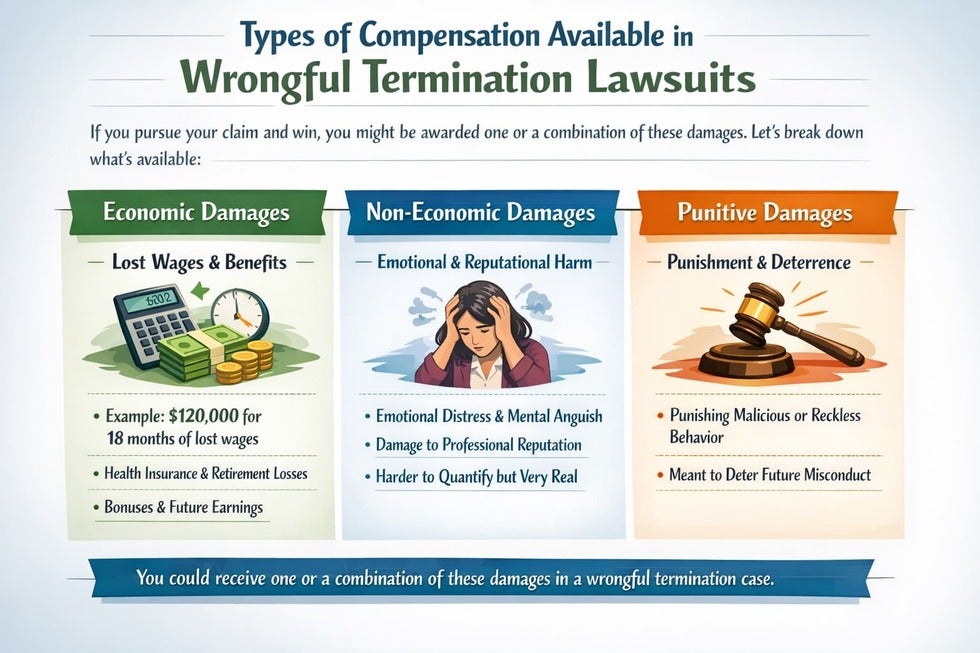
There are three types of compensation available in settlements, which are economic damages, non-economic damages, and punitive damages. If you pursue your claim and win, you might be awarded one or a combination of these damages. In this section I am going to break down what is available and provide examples.
- Economic Damages: This is lost wages, lost benefits, and future earnings you'll miss out on. If you made $80,000 a year and it takes you 18 months to find comparable work, we're looking at $120,000 in lost wages. Add in the employer-paid portion of your health insurance, retirement contributions, and any bonuses you would've received, and the numbers climb fast.
- Non-Economic Damages: Emotional distress, mental anguish, damage to your professional reputation. These are harder to quantify, but they're real. Courts in California could award substantial verdicts for the psychological impact of wrongful termination.
- Punitive Damages: Punitive damages aren't about making you whole, they're about punishing the employer and deterring others from doing something similar. This is something you will only receive when your employer's actions are malicious or reckless.
Proving Wrongful Termination in California
Proving wrongful termination can be tricky, especially when employers rarely admit to illegal motives. If an employer decides to use reasons such as "performance issues" or "restructuring" or "not a good fit" those reasons need to be overcome with evidence that shows the real reason was illegal.
Gathering Evidence for Your Case
Start collecting evidence the moment you suspect something's wrong. Don't wait until after you're fired. This means emails, contracts, pay stubs, the whole nine yards. And don't forget to get statements from colleagues who witnessed any questionable behavior; their statement can add serious weight to your argument.
What you need:
- All employment contracts and offer letters
- Performance reviews, especially positive ones
- Emails or text messages that show discriminatory comments or harassment
- Documentation of any complaints you made to HR
- Pay stubs showing your compensation
- Medical records if you suffered emotional distress
- Witness statements from coworkers who saw what happened
Beyond direct evidence, look for patterns. Were other employees in your protected class treated differently? Did someone younger or of a different race get the promotion you were promised? Was the "performance issue" they cited actually documented anywhere before they fired you?
My Opinion: "Not a Good Fit" Is Often a Red Flag, Not a Reason
In my career, I've seen employers use vague language like "not a good fit" or "performance issues" as cover stories more times than I can count. Here's the tell: if you have years of positive reviews and then suddenly, shortly after reporting harassment or taking medical leave or announcing a pregnancy, you're being managed out with phantom performance problems — that pattern is exactly what a jury notices. Employers assume vague language protects them. What it actually does is give us room to argue. When there's no paper trail of documented performance issues prior to termination, that absence of documentation becomes evidence in your favor. Start preserving everything the moment something feels off.
Calculating Punitive Damages
It's not just about losing your job; it's about justice. And sometimes, that means going after punitive damages to compensate you for what you lost.
Punitive damages aren't awarded because someone made an honest mistake or had a bad day at the office. They come into play for actions that are egregious, think discrimination cases so blatant they make your blood boil or illegal actions by employers who should know better but somehow thought they'd get away with it. If your termination shows malice or reckless indifference, maybe due to sexual harassment or workplace harassment, punitive damages might be on the table.
When pursuing punitive damages, the goal isn't just getting you paid. It's making sure your employer thinks twice before treating another employee the way they treated you.
My Opinion: Punitive Damages Are About More Than Money — They're About Accountability
I want to be candid about punitive damages because people often misunderstand their purpose. Yes, they can significantly increase a settlement or verdict. But their real function is deterrence. When a jury awards punitive damages, they're sending a message to that employer — and every other employer watching — that this behavior has consequences. Over the years, I've seen punitive damage awards transform cases from individual recoveries into meaningful systemic change at companies. Employers who would otherwise settle quietly and move on are forced to confront their culture. If what was done to you was malicious or shockingly indifferent to your rights, pursuing punitive damages isn't about greed. It's about making sure it doesn't happen to the next person.
Frequently Asked Questions About Wrongful Termination Settlements
What qualifies as wrongful termination?
Wrongful termination occurs when an employee is fired for an illegal reason, such as discrimination, retaliation, or refusing to engage in unlawful activity. It can also apply if the firing violates an employment contract or public policy.
Do I need proof to file a wrongful termination claim?
While direct proof like emails or recorded conversations can help, it's not always required. Witness statements, a pattern of behavior, or circumstantial evidence can support your case. An experienced employment lawyer can help gather and present evidence effectively.
How much is the average wrongful termination settlement?
Settlement amounts vary based on lost wages, emotional distress, attorney fees, and punitive damages. In California, wrongful termination cases often settle between $40,000 and $120,000, but high-value cases can exceed $500,000 depending on the facts.
What factors affect how much I could receive?
Key factors include: Your lost income (past and future), Emotional distress and mental suffering, Strength of your legal evidence, Whether your employer acted maliciously or broke the law repeatedly, Whether you're eligible for punitive damages. Use our calculator to get an initial estimate based on these factors.
Is the settlement calculator accurate?
A calculator can provide a helpful estimate based on typical case outcomes and your unique situation. However, every case is different. For a more accurate assessment, we recommend scheduling a free consultation with our legal team.
How long does it take to settle a wrongful termination case?
Some cases resolve within a few months, especially if the employer is willing to negotiate. Others may take a year or more if they go to court. The timeline depends on the complexity of your case, how much evidence is involved, and how your employer responds.
Can I sue for emotional distress or mental anguish?
Yes. If your wrongful termination caused anxiety, depression, or other emotional harm, you may be entitled to compensation for emotional distress - especially if the employer's conduct was particularly harmful or humiliating.
Should I use a lawyer or handle my case alone?
While it's legally possible to represent yourself, employees with an attorney typically recover significantly more. Employers take claims more seriously when you're represented by a skilled employment lawyer who understands how to maximize your compensation.
Know Your Rights, Know What You're Worth
Know your rights, know the law. That's step one in any wrongful termination claim in California. The legal framework is there to protect you - from defining what counts as unfair dismissal to assessing damages like lost wages and emotional distress.
Pick the right partner in this fight; an experienced employment attorney can make all the difference. They'll guide you through gathering evidence, navigating complex laws, and fighting for justice in court if it comes down to it.
You've learned plenty here - about employee protections under state law, how settlements are calculated, even when punitive damages come into play - and now? You're better equipped than ever to take on your wrongful termination case head-on.
If you are in need of a free case evaluation from experienced wrongful termination lawyer, give Kingsley Szamet Employment Lawyers a call or fill out our form. Our experienced legal professionals are available to evaluate your case with you for free. We've helped employees recover more than $300 Million in California alone, and we'd be happy to help you obtain the compensation you deserve. Take advantage of our no win, no fee promise.

Comments
There are no comments for this post. Be the first and Add your Comment below.
Leave a Comment