
Do you work in construction? Are you being paid what you are legally guaranteed? If you work in construction that is being funded completely or partially by government money, then by law you are required to be paid the prevailing wage in California. The prevailing wage is similar to the minimum wage but is specifically for construction workers who are working on public works projects. It is a legally required hourly minimum wage that your employer must pay you.

My name is Eric Kingsley, and I am an employment attorney in Los Angeles who has recovered $400 million in settlements and verdicts with 29 years experience. I can tell you that when prevailing wage laws are violated, employees may be entitled to recover significant unpaid wages, penalties, and other compensation under California law. If you believe that you've been the victim of a prevailing wage case, my law firm offers free consultations to help victims like you learn their options. Simply fill out the contact form on this page to schedule your free one-on-one consultation to get help.
Key Points - Table of Contents
- What is California Prevailing Wage Law?
- Employers Must Pay A Minimum Wage to Employees
- How to Know if You Are Owed Prevailing Wages in Los Angeles
- Common Ways Employers Could Violate Prevailing Wage Laws
- Recovering Unpaid Prevailing Wages in California
- Reviews from Clients of Kingsley Szamet Employment Lawyers
- What Compensation Can a Lawyer Recover for You?
- Frequently Asked Questions
- How a California Prevailing Wage Lawyer Can Help
What is California Prevailing Wage Law?
California's prevailing wage law establishes a wage "floor" for workers on public construction projects to ensure that public funds don't drive down local construction wages. The primary law governing these requirements is found in California Labor Code Sections 1720-1861, which sets out detailed requirements for when prevailing wages must be paid and how they are calculated in Los Angeles wage and hour claims. The Department of Industrial Relations (DIR) is the state agency responsible for setting these rates and enforcing compliance. This isn't a minimum wage, it's a substantially higher wage designed to reflect the actual cost of skilled labor in your area.
How Does Prevailing Wage Work in California?
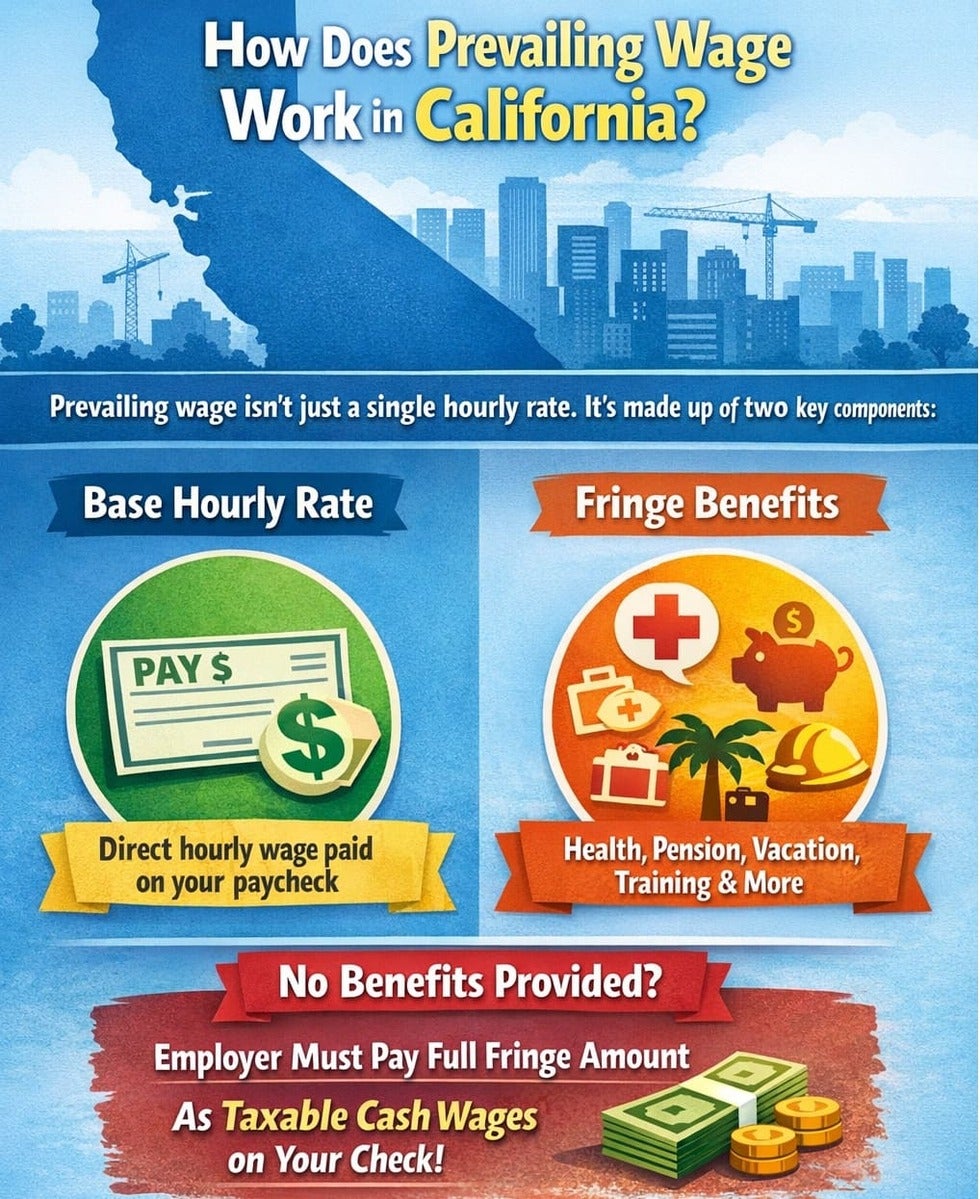
Prevailing wage isn't just a single hourly rate, it's made up of two distinct components that many employers try to confuse or hide. The simplest way I can explain it is by breaking it down into base hourly rate and fringe benefits.
- Base Hourly Rate: This is the direct monetary wage paid to you on your paycheck each pay period.
- Fringe Benefits: This is a set dollar amount for benefits like health insurance, pension contributions, vacation pay, and training. If your employer doesn't provide a qualifying benefit plan that meets DIR regulations, they must pay this entire amount to you as taxable cash wages on your check.
Employers Must Pay A Minimum Wage to Employees
This law prevents employers from winning contracts because they are underpaying their workers. Everyone who bids for the job must at least pay employees the same minimum hourly rate. There is a specific payment amount that is legally required based on the type of work being performed. More information on the history of minimum wage here.
Unfortunately, not everyone follows the law, and when an employer fails to play by the guidelines, it is your paycheck that suffers. Working in construction can be physically draining. You should be paid for how hard you work. The law agrees, and so do we.
How to Know if You Are Owed Prevailing Wages in Los Angeles
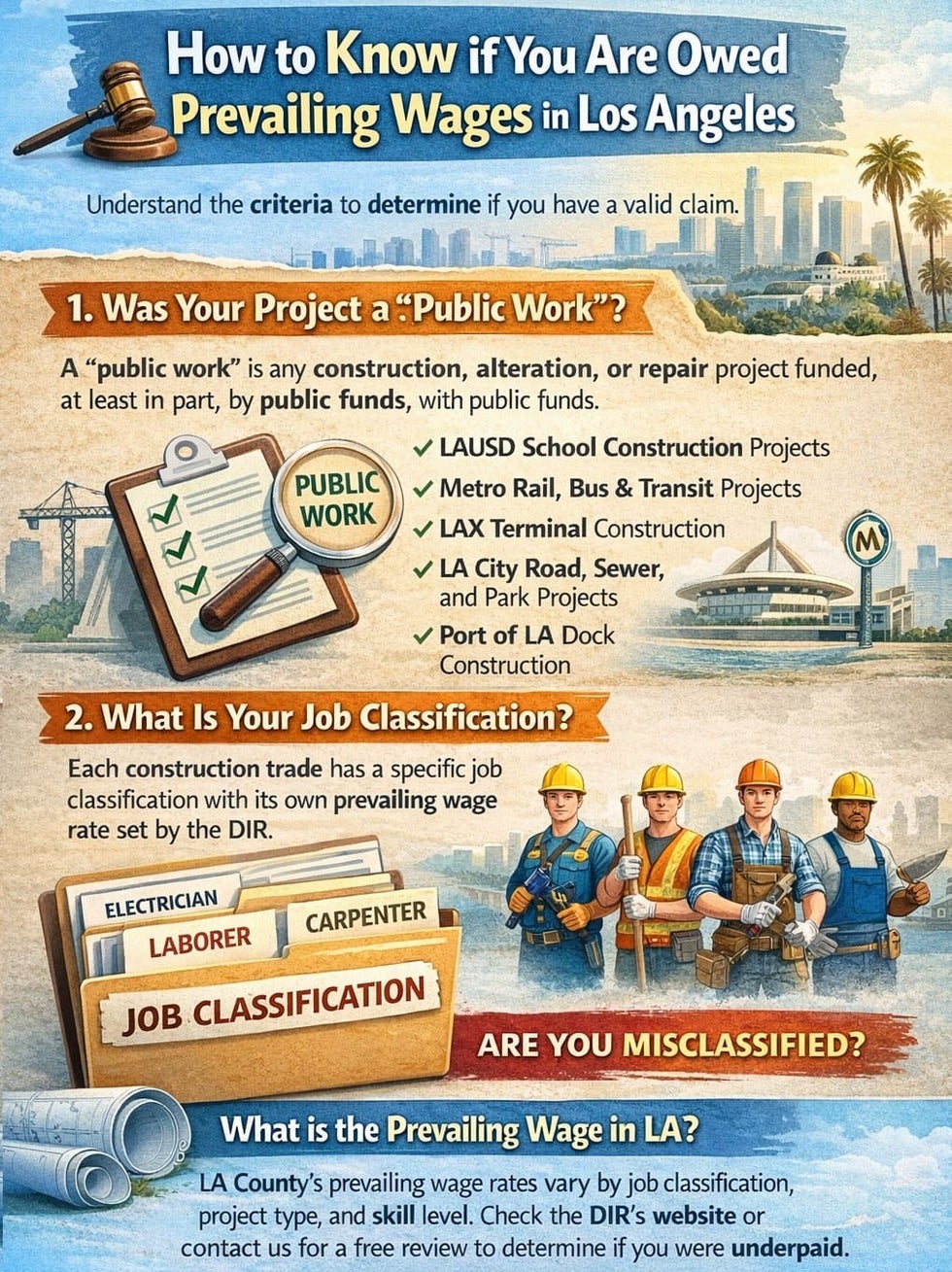
Whether you're entitled to prevailing wages depends on the type of project you worked on and whether your work falls within covered classifications. Some workers could be owed thousands of dollars without realizing it because contractors deliberately obscure these requirements. Understanding the criteria can help you determine if you have a valid claim.
1. Was Your Project a "Public Work"?
A "public work" is any construction, alteration, or repair project that is paid for, in whole or in part, with public funds. Clear examples of public works projects in Los Angeles include:
- LAUSD school construction or modernization projects
- Metro (LACMTA) rail, bus, or transit infrastructure projects
- LAX terminal renovations or construction projects
- City of Los Angeles road repairs, sewer upgrades, or park improvements
- Port of Los Angeles dock or facility construction
2. What Is Your Job Classification?
Every construction trade has a specific job classification with its own prevailing wage rate set by the DIR. Common classifications include electrician, laborer, carpenter, cement mason, and heavy equipment operator. This is where many violations occur because employers will deliberately misclassify skilled workers into lower paid categories to save money. For example, a skilled carpenter might be classified as a general laborer to avoid paying the higher carpenter rate.
What is the Prevailing Wage in LA?
There is no single prevailing wage rate for Los Angeles because the rate varies based on your specific job classification and the county where you worked. Los Angeles County has its own schedule of prevailing wage rates that is updated regularly by the DIR. Each trade and skill level has a different total compensation rate. You can find the exact wage determination for your specific job on the DIR's prevailing wage website, or contact our office for a free review of your pay stubs to determine if you were paid correctly.
Common Ways Employers Could Violate Prevailing Wage Laws
Employers violate prevailing wage laws to cut costs and underbid their competitors on public projects. These violations are wage theft, plain and simple. Here are the most common schemes we see in Los Angeles.
Worker Misclassification
Misclassifying workers is the number one violation in prevailing wage cases. Employers deliberately assign skilled workers to lower paid job classifications to pocket the difference between what they should pay and what they actually pay.
Example (Illustrative): You are a skilled electrician performing electrical work, but your employer classifies you as a "general laborer" on the certified payroll records. This allows them to pay you a lower laborer rate instead of the higher electrician rate, stealing significant wages from each hour you work.
Unpaid or "Stolen" Fringe Benefits
Many employers either fail to provide the required fringe benefits or don't pay you the cash equivalent when they don't offer a qualifying benefit plan. Under prevailing wage law, if an employer doesn't provide a bona fide benefit plan that meets DIR regulations, they must pay you the full fringe benefit amount as cash wages.
Example (Illustrative): The wage determination for your job requires a fringe benefit of several dollars per hour. Your employer provides a basic health plan worth a small portion of that amount but fails to pay you the remaining fringe benefit in cash on your paycheck. You are owed that difference for every hour you worked on the project.
Incorrect Overtime Calculations
Overtime on prevailing wage jobs must be calculated at 1.5 times or 2 times the full prevailing wage rate, not your base rate. This includes overtime for hours worked over 8 in a day, over 40 in a week, and for work performed on the seventh consecutive day of work.
Comparison (Illustrative): Your total prevailing wage rate includes both base wages and employer payments. For overtime, the employer must pay you 1.5 times your total prevailing wage rate, not just 1.5 times your base hourly wage. This violation alone can cost you thousands of dollars.
Note: DIR wage determinations and classification notes control overtime and holiday multipliers, so always check the specific DIR prevailing wage determination for your trade and county.
Failing to Pay for Travel or Subsistence Pay
Some prevailing wage determinations require additional travel pay or subsistence pay when the job site is located a certain distance from the worker's home or the union hall. Employers often ignore these requirements entirely or fail to calculate the correct amounts. These payments are separate from your hourly wage and are meant to compensate you for the extra expense and burden of working at a remote location.
Illegal Deductions or "Kickbacks"
It is illegal under California's prevailing wage laws for an employer to make deductions from your prevailing wage for tools, uniforms, safety equipment, or administrative fees. Some employers also demand that workers return a portion of their wages in cash as a condition of continued employment. Both practices are serious violations that entitle you to penalties and damages.
Recovering Unpaid Prevailing Wages in California
Taking action quickly can protect your rights and maximize your recovery. Here are the essential steps to follow if you believe your employer violated prevailing wage laws.
Keep Personal Records
Do not rely on your employer's records because they are often incomplete or falsified. Keep your own detailed documentation of your work.
- Log your hours every day, including start times, end times, and meal breaks
- Write down the specific tasks you performed each day (for example, "installed conduit" rather than just "electrical work")
- Take photos of the job site sign that lists the general contractor and subcontractors
- Save any documents related to your employment, including offer letters and handbooks
Gather Your Pay Stubs and Certified Payroll Records
Save every pay stub you receive because these documents are critical evidence in a prevailing wage case. Certified Payroll Records (CPRs) are documents that contractors must submit to the agency funding the project, showing what they paid each worker. You have a legal right to request and review these records, and comparing them to your actual pay often reveals violations.
Understand Your Options: DIR vs. Private Lawsuit
You have two main paths to recover unpaid prevailing wages, and understanding the difference can help you make the best choice for your situation.
| Feature | Filing a DIR Complaint | Hiring a Private Lawyer (Lawsuit) |
|---|---|---|
| Who They Represent | The DIR represents the State of California and enforces the law generally. | Your lawyer represents YOU and your individual interests. |
| Speed | Can be very slow, often taking a year or more. | May proceed more quickly with an experienced attorney, though timelines vary. |
| Penalties | May recover basic unpaid wages. | Can recover wages plus waiting time penalties, interest, and other remedies. |
| Control | You have little to no control over the investigation or outcome. | You and your lawyer control the case strategy and decisions. |
| Cost | Free to file. | No upfront cost; lawyers work on contingency (a percentage of what you win). |
Reviews from Clients of Kingsley Szamet Employment Lawyers
"I highly recommend this firm. The whole team was so professional, I Always felt supported, And well taken care off. Thank yo y for everything! And of course we won the case. I never had doubts. They Are fierce. Great job!!!" - Gina E. via Google Review
"I can't recommend Kingsley & Szamet highly enough! From the start, they took care of everything, making the entire legal process stress-free for me. I was worried because I didn't have access to many of the documents I thought I'd need from my former employer, but the team assured me they could work with what I had - and they did exactly that.
Their expertise and persistence led to a successful settlement, and I barely had to lift a finger. They knew exactly how to present my case, negotiate effectively, and get my prior employer to agree to fair compensation. I truly appreciate their professionalism, dedication, and hard work." - Angel E. via Google Review
"Very happy with Eric K. and Jessica A., they went above and beyond in all aspects of my case. I'm very happy with the results." - Brett B. via Google Review
What Compensation Can a Lawyer Recover for You?
When you hire a Los Angeles prevailing wage lawyer, you can recover far more than just the wages you were shorted. California law provides multiple forms of compensation to make you whole and punish employers who violate wage laws.
- Unpaid Prevailing Wages: The full amount you were underpaid, calculated as the difference between what you should have been paid and what you actually received.
- Unpaid Overtime: All overtime hours recalculated at the correct prevailing wage rate, including time and a half and double time.
- Liquidated Damages: In many wage suits, an employee can recover liquidated damages equal to unpaid wages plus interest under California Labor Code Section 1194.2, and prevailing wage enforcement can also include additional penalties under the Public Works laws. Whether liquidated damages apply depends on the specific claim and the employer's defenses.
- Interest: You may be entitled to interest on unpaid wages under California Civil Code Section 3289 and Labor Code Section 218.6, commonly calculated at 10% per year unless a contract specifies otherwise.
- Waiting Time Penalties: Under California Labor Code Section 203, if your employer willfully fails to pay all wages owed when you are terminated or quit, you can recover up to 30 days of your daily wage as a penalty.
- Attorney's Fees and Costs: Under Labor Code Section 218.5, prevailing employees in wage suits can recover reasonable attorney's fees and costs, which means you keep more of the money you recover.
Frequently Asked Questions
What is California's prevailing wage law?
California's prevailing wage law, found in Labor Code Sections 1720 through 1861, requires that workers on publicly funded construction projects be paid a specific wage rate that reflects the actual cost of skilled labor in their area.
What is the 72 hour rule in California?
The "72 hour rule" under Labor Code Section 202 concerns final pay timing: if you quit without giving at least 72 hours' notice, your employer has 72 hours to provide your final paycheck; if you give 72 hours' notice, your final pay is due the day you quit.
How much do lawyers charge per hour in Los Angeles?
Prevailing wage lawyers typically work on a contingency fee basis, meaning you pay nothing upfront and the lawyer only gets paid a percentage of the money successfully recovered for you.
What is the prevailing wage in LA?
There isn't one single prevailing wage because rates vary by Los Angeles County and your specific job classification, such as plumber, laborer, or equipment operator. You can find current rates on the DIR website or contact us for a free review of your pay stubs.
How long do I have to file a prevailing wage claim?
Many wage claims have a three year statute of limitations, though the timeframe can vary depending on the type of claim (written contract claims may have four years, oral promises two years). It's important to act promptly to preserve your rights and evidence.
Can my employer fire me for asking about prevailing wages?
No, it is illegal under California law for your employer to retaliate against you by firing, demoting, or reducing your hours for asking about your pay or filing a wage claim. If this happens, you may have a separate claim for wrongful termination and retaliation.
How a California Prevailing Wage Lawyer Can Help
If you are not sure if you are being paid what the law says is fair, contact us now. In each case, there are time limits that apply. The experienced wage and hour lawyers at Kingsley Szamet Employment Lawyers have specialized knowledge in prevailing wage law cases. We know the details of the law. We know how to win here in California. With our help, your hard work will not go underpaid. We will get you what you are legally promised.
Using a trusted employment lawyer to help protect your rights and obtain compensation is one of the best steps you can take in a situation like this.
Take advantage of our free consultation to discuss how we can help. Fill out the contact form on this page or call (818) 990-8300 now. Do not wait. It is your hard-earned money.
Kingsley Szamet Employment Lawyers
16133 Ventura Blvd #1200
Encino, CA 91436
(818) 572-4143
