
If you have been fired, passed over for a promotion, denied a reasonable accommodation, or harassed at work because of your religion, you have rights under both California and federal law, and the experienced attorneys at Kingsley Szamet Employer Lawyers are here to enforce them. We have been helping victims since 1997, with $300 million recovered, and a no fee unless we win guarantee. Our firm has helped workers throughout Los Angeles stand up to employers who violated their religious rights. If you are in need of a Los Angeles religious discrimination attorney, call (818) 990-8300 today for a free, confidential consultation.
What Is Religious Discrimination?

Religious discrimination occurs when an employer treats an employee or job applicant unfavorably because of their religious beliefs, practices, or observances. It is illegal under both federal and California law, and it covers far more than just formal, organized religions.
Under California's Fair Employment and Housing Act (FEHA) and Title VII of the Civil Rights Act, "religion" is defined broadly. It includes:
- Traditional organized religions such as Christianity, Judaism, Islam, Hinduism, Buddhism, and Sikhism
- Seventh-day Adventism, Jehovah's Witness, and other minority Christian denominations
- Non-traditional and personal belief systems, if an individual sincerely holds a moral or ethical belief that occupies the same place in their life as a traditional religion, it qualifies for protection even if it is not part of any organized faith
- Lack of religious belief, atheists and agnostics are also protected from discrimination
The definition of "religious belief, observance or practice" now includes religious dress and grooming practices.
This includes:
- Wearing or carrying religious clothing
- Wearing head or face coverings
- Wearing jewelry
- Carrying artifacts
- Forms of head, facial or body hair
- Other items that are part of observing one's religion
An accommodation is considered unreasonable if it requires segregation from other employees or the public.
Courts must apply the state definition of "undue hardship" in regards to accommodating an individual's religious beliefs. This means an employer would have to prove that it requires significant difficulty or expense in order to show "undue hardship".
Two Types of Religious Discrimination in the Workplace
California and federal law recognize two distinct forms of religious discrimination. Understanding which applies to your situation is an important first step.
1. Disparate Treatment (Intentional Discrimination)
Disparate treatment occurs when an employer makes an employment decision because of an employee's religion. This is the most straightforward form of discrimination and includes situations such as:
- Refusing to hire an applicant because of their religion or lack of religion
- Terminating an employee to avoid providing a religious accommodation
- Denying a promotion to an employee who wears a hijab, turban, or yarmulke
- Reassigning an employee to a less visible role because management assumes their religious dress makes customers uncomfortable
- Refusing to allow daily prayer breaks that would not disrupt business operations
Importantly, discrimination based on an employer's perception that someone belongs to a certain religion, or based on their association with someone of a particular faith, is also illegal.
2. Disparate Impact (Neutral Policies That Harm a Religious Group)
Disparate impact discrimination occurs when an employer applies a seemingly neutral policy that, in practice, disproportionately harms employees of a particular religion. The employer does not need to have intended to discriminate, if the effect is discriminatory, the policy can be challenged.
Example: A Los Angeles employer adopts a blanket "no head coverings" dress code. While the policy appears neutral, it effectively prevents Muslim women who wear hijab, Jewish men who wear kippot, and Sikh employees who wear turbans from working there, making it potentially unlawful under both Title VII and FEHA.
Religious Discrimination vs. Religious Harassment
Religious discrimination and religious harassment are related but legally distinct claims, and you may have grounds for both.
Religious discrimination involves adverse employment actions taken because of religion such as:
- Being fired
- Demoted
- Passed over
- or denied an accommodation
Religious harassment focuses on conduct that creates a hostile work environment. It may include:
- Repeated offensive jokes or derogatory comments about your religion
- Mocking your religious dress, dietary practices, or prayer habits
- Threatening or intimidating an employee because of their religious beliefs
- Displaying anti-religious imagery or materials in the workplace
For harassment to be actionable, it must be severe or pervasive enough that a reasonable person would find the work environment hostile or abusive. A single offensive comment may not rise to this level, but a pattern of conduct, or a single especially egregious incident, can. If your employer knew about the harassment and failed to stop it, they may be liable. I have an article you can read to learn how to report harassment & discrimination in the workplace for those who might have questions.
Many employees face both forms simultaneously. For example, enduring workplace harassment about their religion and then being passed over for a promotion. If this describes your situation, learn more about hostile work environment claims or contact us for a free evaluation.
Laws That Protect Employees from Religious Discrimination
California employees benefit from overlapping layers of legal protection. Here is a summary of the key laws that apply:
- Title VII of the Civil Rights Act: Federal protection against religious discrimination and requires reasonable accommodation. Employers with 15 or more employees
- California Fair Employment and Housing Act (FEHA): Broader state protections, including accommodation requirements and a lower threshold for coverage. Employers with 5 or more employees
- California Workplace Religious Freedom Act (WFRA): Strengthens FEHA protections by explicitly requiring employers to accommodate religious dress and grooming practices, such as wearing a hijab, yarmulke, or turban, and by setting a higher bar for what constitutes "undue hardship." An employer cannot claim undue hardship based on minor costs or customer preference alone.
Important Case Law Update: Groff v. DeJoy
In June 2023, the U.S. Supreme Court issued a unanimous ruling in Groff v. DeJoy that significantly strengthened employees' rights to religious accommodations nationwide. The Court held that an employer cannot deny a religious accommodation simply because it causes some inconvenience. Instead, the employer must show that the accommodation would result in a substantial burden on the overall conduct of its business.
This is a major change from the previous "more than de minimis cost" standard, which courts had used to make it relatively easy for employers to deny accommodation requests. Under the new standard:
- Employers must make a much stronger showing to justify refusing a religious accommodation
- Minor scheduling inconveniences, small added costs, or employee preference complaints are no longer sufficient to deny an accommodation
- If your religious accommodation request was denied before June 2023, or after, the law may now be more favorable to your claim than you realize
Our attorneys stay current with developments in both California and federal employment law. If you were previously told your accommodation request was lawfully denied, it is worth having that determination reviewed in light of Groff v. DeJoy.
Are There Exceptions? Religious Organization Exemptions
Title VII and FEHA include limited exemptions that allow certain religious organizations to make employment decisions based on religion. However, these exemptions are narrow and do not give religious employers free rein to discriminate in other ways.
- Religious organizations (churches, mosques, synagogues, religious schools) may require employees to share the organization's religion — but only for positions closely tied to carrying out its religious mission
- This exemption does not permit discrimination based on race, sex, disability, or other protected categories
- For-profit businesses with religious owners do not qualify for this exemption
- Many employees working for faith-based nonprofits, hospitals, and universities in the Los Angeles area still have full legal protections
If you work for a religious organization and are unsure whether the exemption applies to your situation, contact us for a free case evaluation.
Compensation Available in Religious Discrimination Cases
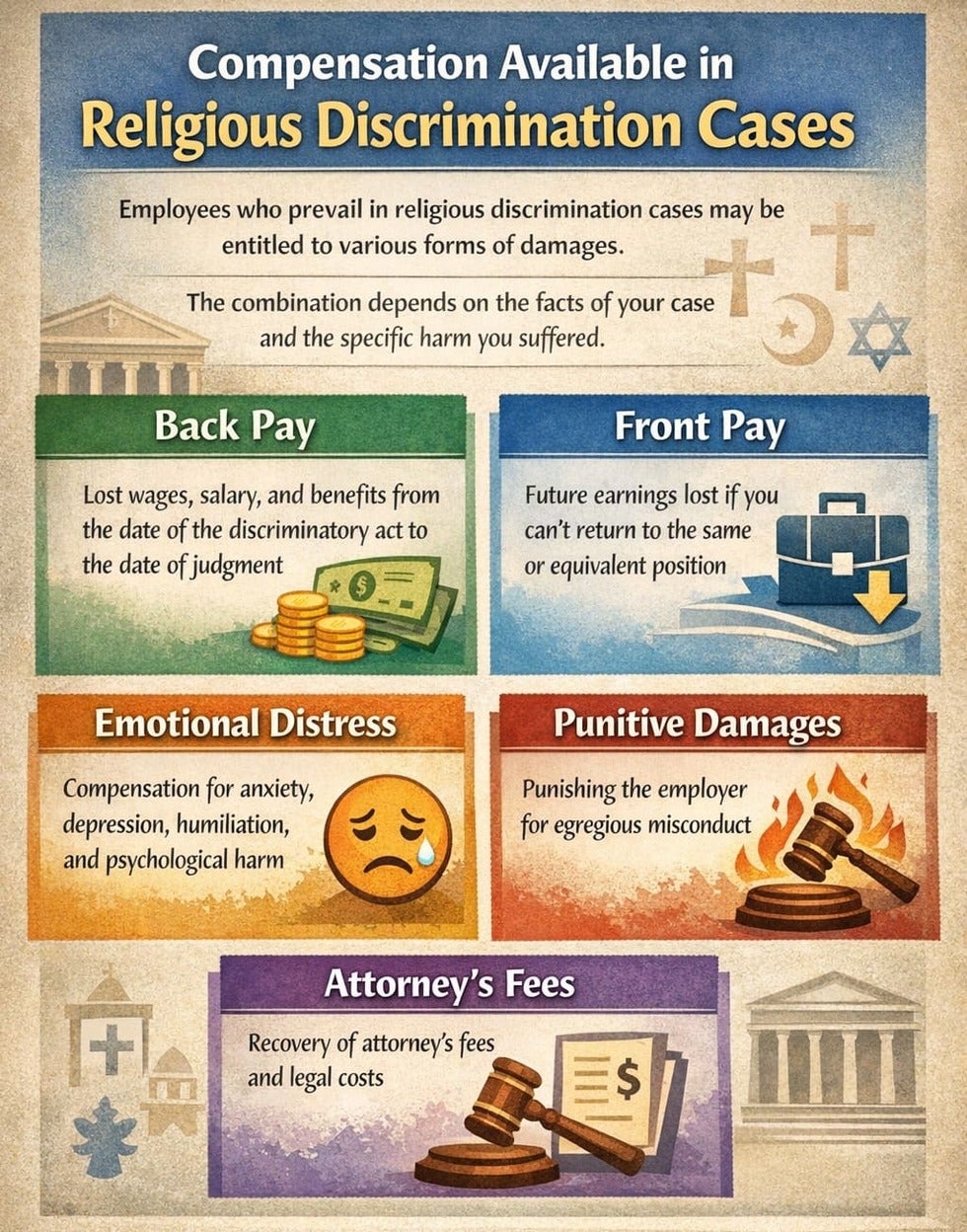
Employees who prevail in religious discrimination cases may be entitled to several categories of damages. The combination depends on the facts of your case and the specific harm you suffered.
- Back pay: Lost wages, salary, and benefits from the date of the discriminatory act to the date of judgment or settlement
- Front pay: Estimated future earnings lost because the employee cannot return to the same or equivalent position
- Emotional distress: Compensation for anxiety, depression, humiliation, and other psychological harm caused by the discrimination
- Punitive damages: Available in egregious cases to punish the employer and deter future misconduct
- Attorney's fees: Under FEHA, prevailing employees can recover their attorney's fees and litigation costs from the employer
Steps to Take If You're Experiencing Religious Discrimination in Los Angeles
Religious discrimination can be a stressful and overwhelming experience, but you don't have to face it alone. If you believe you've been discriminated against based on your religion, what you do in the days and weeks after the incident matters. Here's a step-by-step guide to protect your rights and take action:
1. Recognize the Signs of Religious Discrimination
Discrimination can come in many forms, including:
- Harassment: Offensive comments, jokes, or actions about your religion.
- Unequal Treatment: Being denied promotions, raises, or opportunities due to your religion.
- Refusal of Accommodations: Your employer refusing reasonable accommodations for religious practices, such as prayer breaks or religious dress.
If you've noticed these behaviors, it's important to act.
2. Document Everything
Keeping detailed records can strengthen your case. Be sure to:
- Write Down Incidents: Note the date, time, location, and details of the discrimination. Include the names of those involved and any witnesses.
- Save Evidence: Keep emails, text messages, photos, or any documentation that supports your claim.
- Track Your Performance: Maintain records of your work performance in case the employer claims the discrimination was due to poor performance.
3. Report the Discrimination Internally
Many workplaces have policies in place for addressing discrimination.
- File a Complaint with HR: Follow your company's procedures for reporting discrimination. Be clear about the incidents and provide evidence.
- Keep a Copy of the Report: Always retain a copy of your complaint and any responses you receive from HR or management.
Tip: If you fear retaliation, document your concerns and include them in your report.
4. Seek Legal Advice Early
If the discrimination continues, or if your complaint is ignored, consult our Los Angeles employment attorneys with extensive experience in religious discrimination cases. Our lawyers can:
- Help you understand your rights under California and federal law.
- Advise you on the strength of your case.
- Guide you on the next steps, such as filing a claim or pursuing a lawsuit.
Get the Help You Need by Contacting Kingsley Szamet Employment Lawyers Today
At Kingsley Szamet Employment Lawyers, we represent workplace discrimination victims throughout the entire Greater Los Angeles area. Many of our clients live or work in Downtown LA, Hollywood, and the Westside, choosing to make the short drive down the 101 to our office for our proven track record and private environment. With $300 million in settlements and verdicts, and a contingency fee structure that means you pay nothing unless we win, we're ready to evaluate your case for free and tell you where you stand. Contact us today to schedule your free consultation.
Take the first step in protecting yourself by scheduling your initial consultation with our Los Angeles religious discrimination lawyers.
Complete our online form or dial (818) 990-8300 today.
Frequently Asked Questions
Can I sue my employer for religious discrimination in California?
Yes. If your employer discriminated against you, harassed you, or refused to provide a reasonable accommodation for your religious beliefs or practices, you may have a claim under Title VII of the Civil Rights Act and/or the California Fair Employment and Housing Act (FEHA).
How long do I have to file a religious discrimination claim in Los Angeles?
Under California's FEHA, you generally have 3 years from the date of the discriminatory act to file a complaint with the California Civil Rights Department. If you plan to pursue a federal claim under Title VII, you have 300 days to file with the EEOC. After receiving a right-to-sue letter, you have 1 year (FEHA) or 90 days (federal) to file in court. These deadlines are firm, missing them can permanently bar your claim. Contact us as soon as possible.
Does my employer have to be a large company for me to have a claim?
No. Title VII applies to employers with 15 or more employees. California's FEHA applies to employers with as few as 5 employees. If your employer has at least 5 employees, California law likely protects you.
My employer is a religious organization. Can they still discriminate against me?
Religious organizations have a narrow exemption that allows them to require employees to share their faith for positions central to the organization's religious mission. If you work for a religious employer, it is worth consulting an attorney to understand where you stand.
