
In California, settlements will vary based on a number of different factors, and unfortunately, settlement ranges can vary greatly depending on the facts involved for each unique individual case. In general, I would expect a number of claims to range from $5,000 to $120,000, though cases involving serious misconduct, high earners, or strong documentary evidence may produce results well above those figures. For a breakdown of what the numbers might look like across different case types, visit our page on average wrongful termination settlement amounts in California.
Key Points - Table of Contents
- Settlement Award Data
- California's 5-Employee Rule
- Class Action Claims
- "Damages" That Affect Wrongful Termination Settlements
- Other Factors Affecting Settlement And Verdict Amounts
- Pitfalls To Avoid
- Free Consultation From Experienced Wrongful Termination Lawyers
Wrongful Termination Settlement Data
Before deciding whether to pursue a claim, most people want some sense of where their case might fall. Kingsley Szamet Employment Lawyers has been securing wrongful termination settlements and verdicts since 1997. Having assisted hundreds of victims in employment law, the following is our internal data detailing what those victims received:
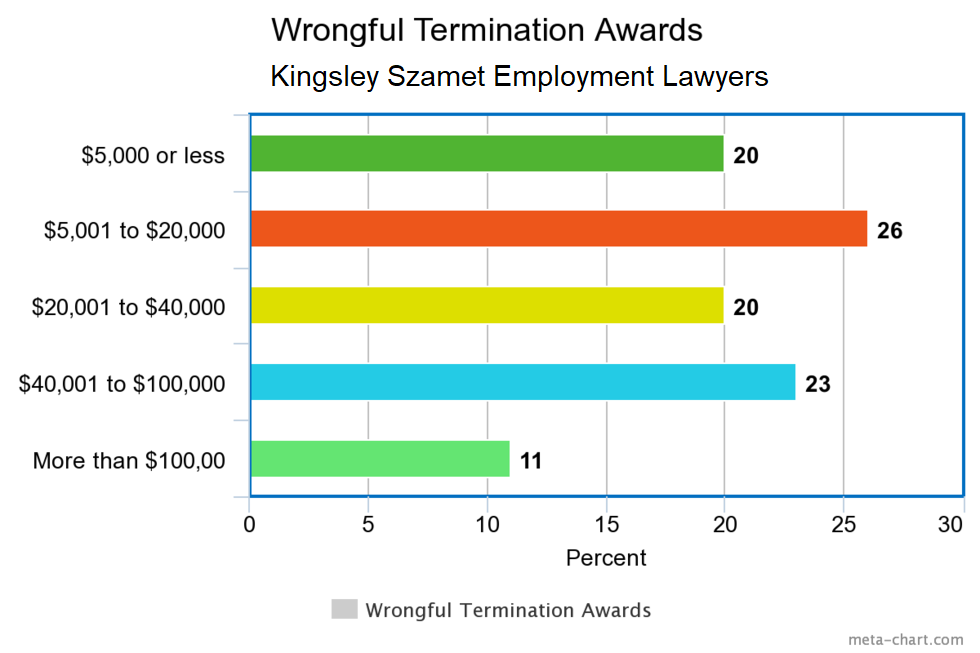
Any published statewide "average" carries an important caveat: the a number of California employment cases settle under confidentiality agreements and are never counted in any database. The figures that do surface publicly may have come from cases that went to trial, which could skews averages toward the strongest, highest-value claims. The only number that should drive your decision is what your own facts support. If you want to learn more about your claim, it is best to speak with a wrongful termination attorney in Los Angeles to learn more about your options.
California's 5-Employee Rule: You May Have More Rights Than You Think
Most people assume that employment discrimination laws only protect workers at large companies. That assumption is wrong in California, and it leads many employees to walk away from valid claims without ever consulting an attorney.
Federal anti-discrimination statutes, including Title VII, the Americans with Disabilities Act, and the Age Discrimination in Employment Act, apply only to employers with 15 or more employees. Workers at smaller businesses are left outside federal protections entirely.
California's Fair Employment and Housing Act sets a far lower bar. FEHA applies to any employer with 5 or more employees, making it one of the broadest anti-discrimination statutes in the country. If your employer had at least five people on payroll when you were terminated, FEHA's full protections apply to your situation regardless of how small the company is, including the right to sue, the right to recover uncapped compensatory and emotional distress damages, the ability to pursue punitive damages when the employer acted with malice or oppression, and fee-shifting provisions that require the employer to pay your attorney's fees if you prevail.
This matters enormously in practice. California's economy is built on small businesses, startups, family-owned companies, and local franchises, many of which have between 5 and 50 employees. Workers at these companies are routinely told, or assume, that they have no legal recourse because their employer is "too small." In most cases, that belief is incorrect.
There is one area where company size remains relevant: the ceiling on punitive damages. Courts and juries weigh an employer's financial resources when setting punitive awards, so a small business will generally face a lower punitive damages figure than a large corporation. But the underlying right to recover compensatory damages, back pay, front pay, and emotional distress is unaffected by the employer's size.
When Your Termination May Be Part of Something Larger: Class Action Claims
The majority of wrongful termination cases involve a single employee pursuing a claim against a single employer. But some terminations are not isolated decisions, they are part of a broader pattern of illegal conduct affecting multiple workers at the same company. When that is the situation, a class action lawsuit may be the appropriate vehicle, and the compensation dynamics shift significantly.
Kingsley Szamet Employment Lawyers has handled more than 150 class actions over nearly three decades of practice in California. That depth of experience gives our attorneys a perspective that most employment firms simply do not have: the ability to recognize, early in a case evaluation, whether an individual termination is actually a symptom of a company-wide problem.
Three fact patterns that frequently signal class action potential:
A mass layoff or reduction in force that disproportionately affected a protected group, employees over 40, women, workers of a particular race or national origin, or employees who had recently engaged in protected activity such as filing an HR complaint or requesting a medical leave. California law and the federal WARN Act impose specific obligations on employers conducting large-scale layoffs, and violations are common.
A company-wide practice, whether written in policy or applied informally by management, of terminating employees who assert their legal rights. When multiple workers at the same employer were fired in similar circumstances after filing workers' compensation claims, requesting reasonable accommodations, or reporting safety or legal violations, that pattern can form the foundation of a class action.
A performance evaluation or ranking system that produces statistically disparate outcomes across protected groups, is applied inconsistently based on protected characteristics, or is being used as a pretext to eliminate a specific category of employees. These systemic issues underlie many of the largest employment class actions in California history.
Employment class actions change the financial calculus of a case in two important ways. First, the employer's aggregate exposure grows with each additional class member, which substantially increases their incentive to reach a settlement rather than face trial. Second, FEHA and applicable federal statutes require the employer to pay attorney's fees in a successful class action, which means legal costs come out of the employer's pocket, not yours. If you were terminated and have reason to believe colleagues at your company experienced similar treatment, that information is important to share when you speak with us. What looks like one person's case may be the starting point for a significantly broader recovery.
"Damages" That Affect Wrongful Termination Settlements
Understanding the various types of damages available in a wrongful termination case is essential, as the specific circumstances of your situation will determine which forms of compensation you may be entitled to recover. From lost wages and medical expenses to punitive damages, the following breakdown outlines the key categories of damages that can significantly impact the outcome of a wrongful termination settlement.
Lost Earnings And Benefits
Wrongful termination cases typically compensate plaintiffs for lost back pay, which is essentially based on the earnings they would have received had they remained with the employer. Lost earnings typically also include bonuses and "earnings growth," which takes into account regular pay increases, cost-of-living adjustments, promotions, etc. It is important to remember plaintiffs are expected to "mitigate their losses." This means, if you have been terminated, you are expected to find a similar job with similar pay as soon as possible.
If an employee deliberately fails to mitigate losses in this manner, and if an employer is able to prove that, calculated mitigation sums may be subtracted from the compensation for lost earnings. Benefits are also an important component of compensation packages. So, it is important that lost benefits be included in economic damages calculations in wrongful termination lawsuits. Benefits include healthcare coverage, dental and vision coverage, pension plans, retirement savings, stock options, and other employer-provided reimbursements.
Medical Expenses:
A job loss can have significant effects not just on the emotional health of an employee, but also on his or her physical health. Emotional stresses also manifest as physical ailments.
Wrongful termination lawsuits can also seek compensation for medical expenses and any type of psychological counseling the plaintiff needed as a result of emotional distress. In addition, plaintiffs can seek compensation for non-economic damages such as "pain and suffering." Amounts awarded for pain and suffering are dependent on jurors.
Cost Of Job Searches
Job seekers often incur significant costs in their efforts to find employment after a wrongful termination.
Examples of costs that might be incurred during job searches include membership in professional organizations (networking), attending job fairs, travel expenses, wardrobe expenses, etc. A study showed that plaintiffs who filed for this type of damages received a much larger award than those who did not claim compensation for job search costs.
Attorney Fees
In some wrongful termination cases, the fees paid to attorneys may also be recoverable in addition to any court costs that were incurred. Each case is unique and it is best to consult with you attorney to determine if your lawyer fees may be covered.
Punitive Damages
This is the amount the court can order the employer to pay for actions that are particularly outrageous or egregious. While other types of damages are meant to compensate or reimburse employees for their losses, punitive damages are intended to punish the employer and deter similar behavior by others in the future. These damages are intended to deter similar behavior in the future and serve as a form of societal retribution within the realm of civil litigation.
These types of damages may not be available for all wrongful termination claims. The amount of such damages is typically entirely up to the jury.
Other Factors Affecting Settlement And Verdict Amounts
When you file a wrongful termination lawsuit, the burden of proof is typically on you, the plaintiff.
What this means is, if you claim that you have been wrongfully terminated, you must prove why your termination was illegal or wrongful.
For example, if you were sexually harassed or forced to quit because of discrimination or a hostile work environment, your sexual harassment attorney would need you to help provide evidence of discrimination and/or harassment to prove that you were wrongfully terminated.
The amount of damages in wrongful termination lawsuits often depends on the type of claims.
For example, in a whistleblower lawsuit, where employees expose their employer for defrauding the government, plaintiffs may be able to receive a percentage of recovered money, which could easily add up to millions of dollars. The experience and caliber of your employment lawyer can also make a big difference when it comes to the amount of compensation you can get in your wrongful termination lawsuit.
Some of the factors that could have an impact on the settlement amount include your lawyer's knowledge, experience, track record handling similar cases and above all, his or her ability to negotiate a larger settlement.
There is no question that strong negotiators will garner a higher settlement. It is also a fact that most employment lawsuits, including wrongful termination cases, end up in an out-of-court settlement rather than go to trial.
Since litigation can be an expensive and lengthy process for all concerned, negotiating a settlement might be an ideal option in most cases.
However, if the employer is not willing to come to the table or offer a fair settlement, going to trial may be the only option. So, you need a lawyer who is both a skilled negotiator and an excellent trial attorney.
Pitfalls To Avoid
It would be in your best interest to not accept the first settlement offer.
Never rush into a settlement before all details of the case become apparent and you understand the full scope of the case.
Once you accept the settlement offer, your case will be considered closed and you cannot seek any further compensation. A survey by Nolo.com showed that those who negotiated received twice the settlement amount compared to those who did not. Your employment lawyer will leverage the evidence to help you secure the best possible settlement.
Studies and research also show that filing a wrongful termination lawsuit tends to increase the final settlement amount and increase the chances of receiving a settlement.
When you file a formal lawsuit, it triggers the discovery process where evidence is gathered. When valuable evidence is uncovered during this process, you are placed in a stronger position at the negotiating table.
Free Consultation From Experienced Wrongful Termination Lawyers
California's statutes of limitations begin running on the day you are terminated or constructively forced to resign. Time spent waiting is time spent narrowing your options, evidence becomes harder to gather, witnesses move on, and deadlines close in. If you or a loved one has been mistreated, harassed, discriminated against or wrongfully terminated from your job, the experienced Los Angeles wrongful termination attorneys at Kingsley Szamet Employment Lawyers can help you better understand your legal rights and options.
We offer a no-win-no-fee guarantee, which means you don't pay us fees unless we recover compensation for you.
Call us at (818) 990-8300 to schedule your free consultation and comprehensive case evaluation.


Comments
There are no comments for this post. Be the first and Add your Comment below.
Leave a Comment