
Getting fired feels terrible. Getting fired illegally? That's a whole different story, and yes, you can sue for it.
I've spent 29 years representing employees in California, and I can tell you this: wrongful termination cases are winnable when you have the right evidence and approach. Knowing what do do if your fired unfairly is a critical step. Over the last three decades, my firm has secured over $300 million in settlements and verdicts for workers who were illegally fired.
Let me walk you through what wrongful termination actually means in California, when you can sue, and what I've learned from handling more than 150 class actions and countless individual cases in state and federal courts.
Table of Contents
- What Makes a Termination "Wrongful" in California?
- When Can You Actually Sue?
- Proving Your Case: What I Look For
- What You Need to Do Right Now
- Filing Your Claim: The Process
- What Your Case Could Be Worth
- Do You Need a Lawyer?
- California's Unique Protections
- Common Wrongful Termination Scenarios I See
- What Happens After You File
- Your Next Steps
- Frequently Asked Questions
What Makes a Termination "Wrongful" in California?
Here's the thing about California: we're an at-will employment state. That means your employer can fire you for almost any reason, or no reason at all. But there are critical exceptions to at-will employment in California.
A termination becomes wrongful when your employer fires you for an illegal reason. Based on what I see in real cases, the most common illegal reasons include:
- Workplace Discrimination: Your employer can't fire you because of your race, gender, age (40+), religion, disability, pregnancy, sexual orientation, or other protected characteristics under the California Fair Employment and Housing Act (FEHA).
- Retaliation: I've represented countless workers who were fired after reporting harassment, filing wage claims, requesting reasonable accommodations, taking protected leave, or blowing the whistle on illegal activities. All of these firings are illegal.
- Breach of Contract: If you have an employment contract (written or implied through an employee handbook), your employer must follow its terms. I've seen employers try to skirt around clear contractual promises, and courts don't take kindly to it.
- Violation of Public Policy: California protects employees who exercise legal rights like taking family leave, serving on jury duty, refusing to break the law, or filing workers' compensation claims. Fire someone for these reasons? That's wrongful termination.
- WARN Act Violations: California's version of the Worker Adjustment and Retraining Notification Act requires employers to give advance notice before mass layoffs. Skip this step, and you've got liability.
When Can You Actually Sue?
You can sue when your firing falls into one of those protected categories and if you can prove it was wrongful termination. But timing matters.
California has specific deadlines for wrongful termination claims:
- FEHA claims (discrimination, harassment, retaliation): 3 years
- Public policy violations: 2 years
- WARN Act violations: 3 years
- Whistleblower retaliation: 3 years
- Breach of contract: 2-4 years depending on the contract type
Miss these deadlines and your case is dead, no matter how strong your evidence is.
Proving Your Case: What I Look For
When someone walks into my office saying they were wrongfully terminated, I need to see evidence. The burden of proof sits squarely on you, the employee. You need to work with your Los Angeles employment lawyer to show that it's more likely than not that your employer broke the law.
In employment cases, we use what's called "preponderance of the evidence." Think of it like a scale: if the evidence tips even slightly in your favor, you've met your burden. It's not "beyond a reasonable doubt" like in criminal cases. You just need to show it's more probable than not that the termination was illegal.
The Evidence That Actually Wins Cases
After three decades of this work, I can tell you what evidence moves the needle:
Documentation is everything. Save every email, text, performance review, employee handbook, and termination notice. If your employer gave you a reason for firing you (especially if it doesn't make sense), document it immediately.
Timing tells a story. If you complained about discrimination on Monday and got fired on Friday, that timing is powerful evidence. In cases I've handled, timing has been a critical factor in proving retaliation.
Witness statements matter. Did coworkers hear discriminatory comments? Did anyone see the harassment? Their testimony can be the difference between winning and losing.
Performance records prove inconsistencies. If you have stellar performance reviews but suddenly you're fired for "poor performance" right after requesting medical leave, those records expose the lie.
Patterns of discrimination. Does your employer have a history of firing people in your protected class? Do they replace older workers with younger ones? When you're wondering, what qualifies as workplace discrimination, remember that these types of patterns help prove systemic discrimination.
What You Need to Do Right Now
If you think you've been wrongfully terminated, here's my advice:
Write everything down immediately. Create a detailed timeline with dates, times, names of people present, and exactly what was said. Your memory will fade, but what you write today will be evidence tomorrow.
Gather every document you can. Your personnel file, employment contract, company policies, emails, texts, performance reviews, pay stubs (to calculate damages), and your termination notice. If you still have access to work materials, get copies now. Once you're locked out, they're gone.
Don't sign anything without a wrongful termination lawyer reviewing it. Severance agreements often include releases that waive your right to sue. You might be signing away a case worth hundreds of thousands of dollars for a few weeks of pay.
Talk to coworkers while you can. If anyone witnessed discrimination or can corroborate your account, get their contact information now. They might not be willing to help later if your employer pressures them.
Filing Your Claim: The Process
Where you file depends on the type of wrongful termination claim you have.
For discrimination, harassment, or retaliation under FEHA, you typically file with the California Civil Rights Department (CRD, formerly DFEH). The CRD investigates and issues a "right-to-sue" notice, which you need before filing in court.
For federal discrimination claims, you file with the Equal Employment Opportunity Commission (EEOC). California and the EEOC have a work-sharing agreement, so filing with one often covers both.
For breach of contract or public policy violations, you usually go straight to civil court (state or federal, depending on the circumstances).
This is where having an experienced employment lawyer becomes critical. We know which agency to file with, what forms to use, and how to navigate the procedural requirements that can kill an otherwise strong case.
What Your Case Could Be Worth
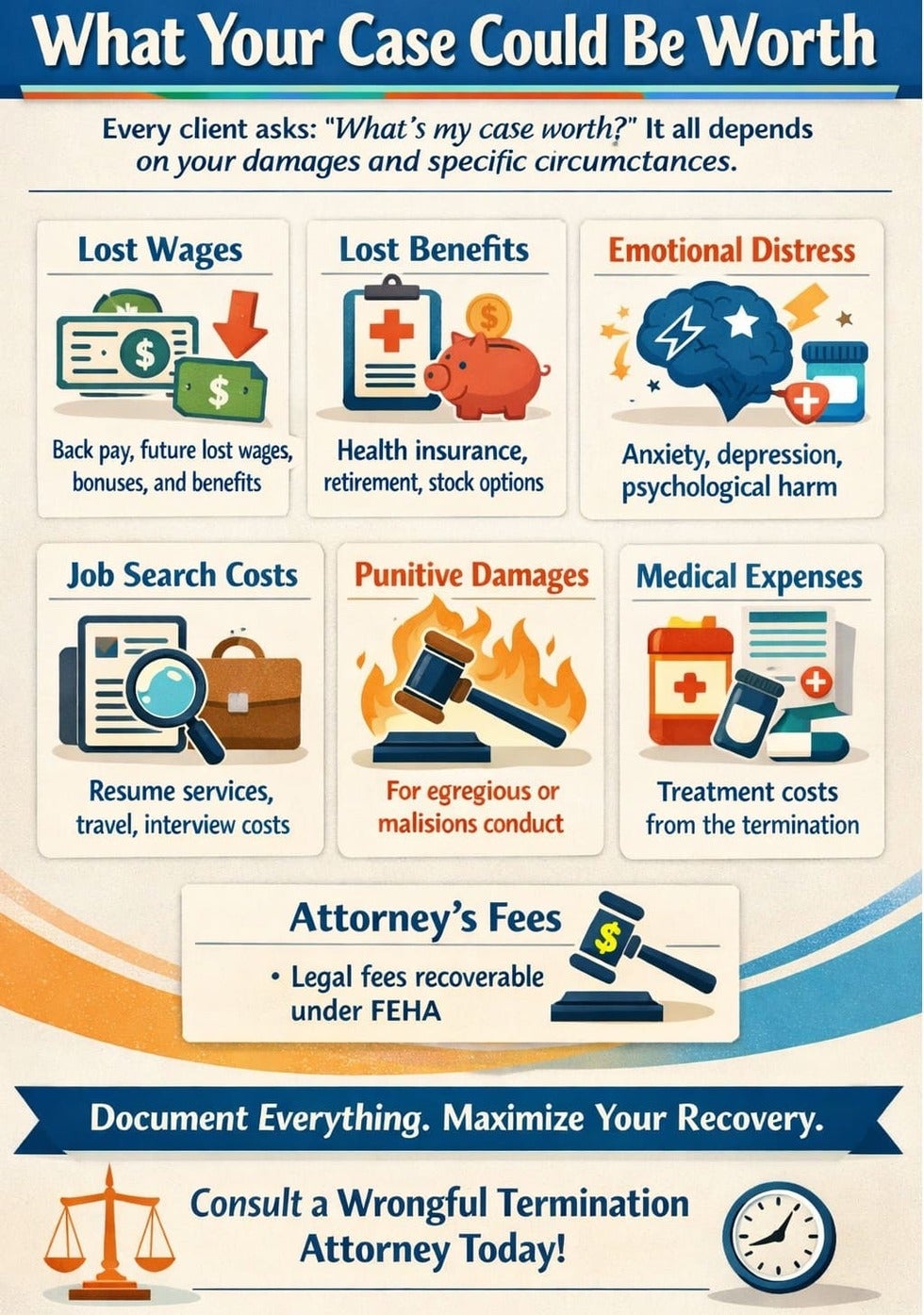
Every client asks: "What's my case worth?" While there are What's my case worth?, the answer really depends on your damages and specific circumstances.
Lost wages include back pay (what you would have earned if you'd kept your job), future lost wages (if you're earning less at a new job), bonuses, raises, and benefits. You're expected to "mitigate" by looking for comparable work, but if you're making less, you can claim the difference.
Lost benefits like health insurance, retirement contributions, stock options, and pension accruals are often substantial. I've seen cases where lost benefits exceeded lost wages.
Emotional distress is real and compensable. If your wrongful termination caused anxiety, depression, or other psychological harm, you can recover for that. Medical documentation from a therapist or psychiatrist strengthens these claims significantly.
Medical expenses from losing your health insurance or needing treatment for emotional distress caused by the termination.
Job search costs including resume services, career coaching, and travel to interviews. Clients who document these costs typically recover three times more than those who don't.
Punitive damages are available when an employer's conduct is especially egregious, fraudulent, or malicious. These are meant to punish the employer and deter similar conduct.
Attorney's fees can sometimes be recovered in wrongful termination cases, particularly under FEHA.
Do You Need a Lawyer?
Technically, no. You can file EEOC and CRD complaints yourself.
But here's what I tell people: There are a number of examples of wrongful termination that continue to demonstrate just how complex these cases can be. Employers have experienced lawyers defending them, and you're going up against companies with deep pockets and every incentive to fight you.
An experienced employment lawyer knows how to:
- Identify which laws your employer violated
- File in the right agency or court
- Meet critical deadlines
- Force your employer to produce documents during discovery
- Depose your employer and witnesses under oath
- Calculate the full value of your damages
- Navigate settlement negotiations
- Take your case to trial if necessary
At Kingsley Szamet, we offer free consultations and work on contingency, meaning we only get paid if you win. You don't pay upfront fees. We only take a percentage of what we recover for you.
Studies consistently show that plaintiffs with lawyers recover significantly more than those without, even after paying attorney's fees. The expertise and resources we bring to your case typically result in settlements and verdicts that far exceed what you could get on your own.
California's Unique Protections
California employment law is more protective of workers than federal law and most other states. FEHA, for example, covers employers with 5 or more employees, while federal law requires 15. California's statute of limitations for FEHA claims is 3 years, compared to federal deadlines that can be as short as 180-300 days.
California also recognizes several wrongful termination theories that don't exist everywhere:
Constructive discharge occurs when your employer makes your working conditions so intolerable that you're forced to quit. If you resign because of harassment, discrimination, or a hostile work environment, you're legally considered terminated and can sue for wrongful termination.
Implied contract protections mean that even without a written contract, your employer's promises in handbooks, verbal assurances about job security, or established patterns of only firing for cause can create binding obligations.
California's public policy protections are broader than most states, covering everything from refusing to violate the law to taking protected leave to reporting illegal activity.
Common Wrongful Termination Scenarios I See
After 29 years of practice, certain patterns emerge:
The pregnancy termination: Employee announces pregnancy or returns from maternity leave, suddenly there's a "reorganization" and her position is "eliminated." pregnancy. This is textbook pregnancy discrimination.
The medical leave retaliation: Employee requests FMLA or CFRA leave for a serious health condition, gets approved, comes back to work, and is fired within weeks for "performance issues" that were never mentioned before. Classic retaliation.
The whistleblower firing: Employee reports safety violations, accounting fraud, or harassment to management or government agencies. Shortly after, they're fired for a pretextual reason. This is retaliation and violation of public policy.
The age discrimination: Company wants to cut costs, so they lay off older, higher-paid employees and replace them with younger, lower-paid workers. This violates FEHA and federal age discrimination law.
The disability discrimination: Employee discloses a disability and requests reasonable accommodation. Employer refuses, creates impossible working conditions, or fires them claiming they can't perform essential functions (without ever engaging in the interactive process required by law).
What Happens After You File
The process typically unfolds like this:
Discovery: Both sides exchange documents and information. We request your personnel file, company policies, emails, and anything else relevant. We depose (interview under oath) your former supervisors and HR personnel. They depose you.
Mediation: The average wrongful termination settlement is usually settled outside of court before trial. Courts often require mediation, where a neutral third party helps both sides reach a compromise. Having an experienced negotiator on your side is critical here.
Trial: If settlement fails, we go to trial. A judge or jury hears the evidence and decides. I've tried these cases for three decades and won significant verdicts, but trials are unpredictable and expensive. Most cases settle because both sides want to avoid that uncertainty.
Frequently Asked Questions
What is wrongful termination?
Wrongful termination is when an employer fires you for illegal reasons like discrimination, retaliation, or breach of contract, rather than lawful reasons.
Does at-will employment mean I can't sue?
No. Even in at-will California, employers can't fire you for illegal reasons like discrimination or retaliation.
How long do I have to file?
It depends on your claim type: FEHA claims have 3 years, public policy violations have 2 years, and some federal claims have shorter deadlines.
Can I sue if my employer doesn't like me?
Only if they don't like you for an illegal reason (like your race or religion) and took adverse action based on that.
What if I was fired right after filing a workers' comp claim?
That's likely illegal retaliation. Contact an attorney immediately.
Can my employer fire me for reporting illegal activity?
No. Whistleblower protections make this type of retaliation illegal.
Do I need a lawyer?
You're not required to have one, but employers have lawyers defending them, and experienced attorneys typically win much larger recoveries.
What if I signed a severance agreement?
Depending on what you signed, you may have waived your right to sue. Have a lawyer review it immediately.
How much does a wrongful termination lawyer cost?
Most employment lawyers, including us, work on contingency. You don't pay unless we win.
What can I recover in a wrongful termination case?
Lost wages, benefits, emotional distress, medical expenses, job search costs, attorney's fees, and potentially punitive damages.
Your Next Steps
If you believe you've been wrongfully terminated, don't wait. Evidence disappears, witnesses forget, and deadlines pass.
Contact us for a free case evaluation. We'll review your situation, tell you honestly whether you have a case, and explain your options.
We work on contingency, so you don't pay unless we win.
Call us today. Your job may be gone, but your rights aren't.


Comments
There are no comments for this post. Be the first and Add your Comment below.
Leave a Comment