

Partner, Kingsley Szamet Employment Lawyers · California State Bar, Admitted 1996
Experience
29 Years
Recovered
$300M+
Class Actions
150+

Unfair treatment becomes illegal when it's based on protected characteristics like race, age, gender, or disability, or happens in retaliation for reporting discrimination. If you are currently being treated unfairly at work, it can be in your best interest to act fast.
As an employment attorney in Los Angeles, I've been handling employment cases for nearly 30 years and have seen a lot. My advice is simple, act early. The employees who take early action almost always have a better chance than those who suffer in silence.
Here's the reality, unfair treatment happens every day in California workplaces. Some of it is illegal discrimination that violates state and federal law. Some of it is just terrible management that makes your job miserable but doesn't give you legal grounds to sue. The key is knowing the difference.
Here is what you need to know on how to deal with unfair treatment in the workplace:
- What Actually Counts as Unfair Treatment
- Difference Between Unfair vs Illegal Treatment
- Warning Signs You're Experiencing Illegal Treatment
- Disparate Impact: You Don't Always Have to Prove Intent
- What To Do Right Now If You're Being Treated Unfairly
- Should You Go to HR or Not?
- What An Employment Attorney Does for You
- How To File a Claim in California
- Why Experience Matters in Employment Cases
- My Option: California Updates on Unfair Treatment at Work
- Frequently Asked Questions
- Take Action Now
What Actually Counts as Unfair Treatment
Not everything that feels unfair at work is going to be illegal. Your boss being a jerk? Probably not illegal. Your boss being a jerk specifically because you're pregnant? That's illegal discrimination, and we can do something about it.
Under California's Fair Employment and Housing Act (FEHA), you are protected from discrimination based on these characteristics:
- Race and color
- National origin and ancestry
- Religion and creed
- Age (40 and older)
- Sex and gender (including pregnancy)
- Sexual orientation
- Gender identity and expression
- Disability (physical and mental)
- Medical condition
- Genetic information
- Marital status
- Military or veteran status
Federal law through Title VII and the Age Discrimination in Employment Act provides similar protections, though California law often provides even more protections.
The California Civil Rights Department defines discrimination as treating someone differently in employment decisions because of a protected characteristic. Those employment decisions include hiring, firing, promotions, training opportunities, compensation, and pretty much every other aspect of your job. When an employer violates these rights, it may be in your best interest to speak with a Los Angeles discrimination attorney to learn your options.
Difference Between Unfair vs Illegal Treatment: What Most Employees Get Wrong
As I mentioned earlier, not everything that feels unfair at work is illegal. This confuses people more than anything else in employment law.
Unfair treatment at work becomes illegal in California when it is based on a protected characteristic or when it happens in retaliation for protected activity under the Fair Employment and Housing Act or federal law.
Let me break down the three categories to make this more clear:
- Unfair but legal: Your boss plays favorites, micromanages you, or treats you poorly for reasons unrelated to any protected characteristic. This includes promoting friends, being generally rude, or having unreasonable expectations that apply to everyone.
- Unfair and illegal: Your employer makes job decisions, hiring, firing, promoting, paying, or creates a hostile work environment, based on your race, age, gender, disability, pregnancy, religion, sexual orientation, national origin, or other protected characteristics under FEHA.
- Legal until retaliation makes it illegal: You complain about unfair treatment, and then your employer fires you, demotes you, or makes your work life miserable because you complained. That retaliation is illegal even if the original complaint wasn't about discrimination.
Understanding this difference saves you time, stress, and helps you make smart decisions about what to do next.
Scenarios That Cross the Line
In my 29 years practicing employment law, certain patterns signal illegal discrimination. Here are a few examples that may help you better understand the differences.
- A company consistently passes over qualified older workers for promotion and hires significantly younger people with less experience. When decision makers make comments about wanting "fresh blood" or "new energy," that's age discrimination under California law.
- An employer pays women less than men for substantially similar work. If the pay gap can't be explained by seniority, merit, or other legitimate factors, that violates California's Equal Pay Act, and may warrant a consultation with a wage and hour attorney.
- A supervisor makes repeated sexual comments, touches employees inappropriately, or creates a hostile environment based on gender. That's sexual harassment under FEHA.
- An employee requests reasonable accommodations for a disability, like modified work hours or ergonomic equipment, and the employer denies the request without engaging in the interactive process required by law. That's disability discrimination.
- A pregnant employee suddenly receives negative reviews after announcing her pregnancy, despite unchanged performance. When termination follows shortly after, that pattern suggests pregnancy discrimination.
- Workers get fired, demoted, or reassigned immediately after reporting discrimination or harassment. That's retaliation, which is illegal even if the original complaint doesn't result in findings of discrimination.
Warning Signs You're Experiencing Illegal Treatment
Based on what I've observed over nearly three decades, certain red flags can indicate potential legal violations.
You get consistently passed over for promotions despite strong performance reviews, and the pattern lines up with a protected characteristic. When every woman in a department gets overlooked while less qualified men get promoted, that raises serious concerns.
Your pay doesn't match your coworkers who do substantially similar work. In my experience, it is always disheartening to hear about unequal pay due to gender pay gaps where women might earn less than male colleagues in identical roles.
You face hostile comments or isolation directly related to your race, religion, age, disability, or other protected status. Comments about someone's accent, national origin, or age are clear harassment.
Your work conditions change dramatically after you take protected leave under FMLA or CFRA, report discrimination, or assert your rights. California law prohibits retaliation.
You're terminated or demoted without proper documentation or process, especially if it happens right after you complain about discrimination, take medical leave, or request accommodations.
The timing matters. When adverse employment actions happen days or weeks after protected activity, that temporal proximity creates a strong inference of retaliation.
Disparate Impact: You Don't Always Have to Prove Intent
Most people assume that proving discrimination means proving someone deliberately targeted them. That's one way discrimination works, but it's not the only way. California law also recognizes what's called disparate impact discrimination, and understanding it could change how you evaluate your own situation.
Disparate impact occurs when an employer applies a policy or practice that appears neutral on its face but disproportionately disadvantages workers who share a protected characteristic. The key distinction: you don't need to prove that anyone intended to discriminate. You only need to show that the policy produces a discriminatory result.
A few examples of how this plays out in real workplaces: a physical fitness requirement that isn't genuinely necessary for the job may disproportionately screen out women or older workers. A minimum GPA cutoff for hiring can disproportionately exclude certain groups if it doesn't actually predict job performance.
What To Do Right Now If You're Being Treated Unfairly
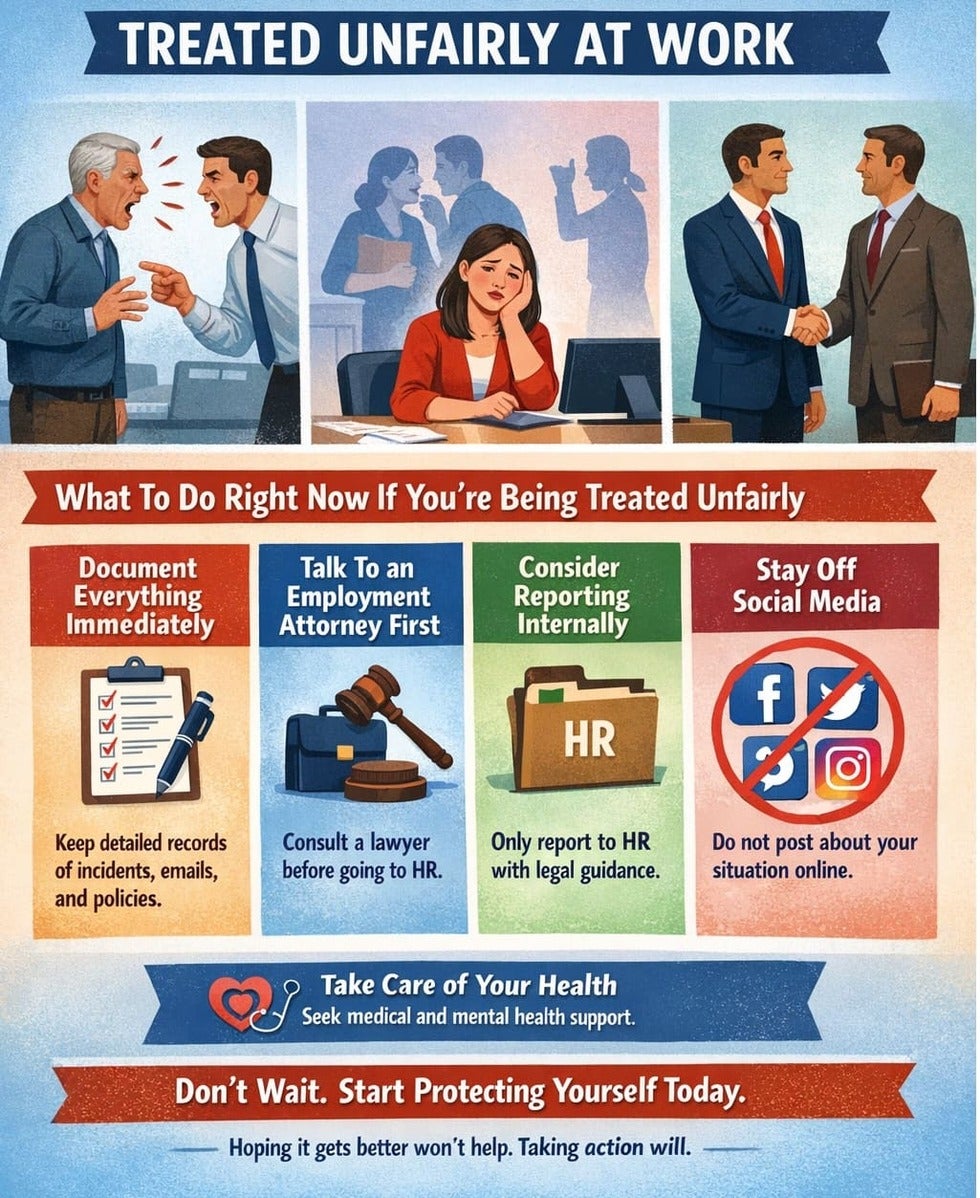
Document everything immediately, consult an employment attorney before talking to HR, and avoid posting about the situation on social media. Stop hoping it will get better on its own. It won't. Here's exactly what you need to do, and the order matters.
Document Everything Immediately
Start keeping a detailed record today. Not next week. Today.
Write down specific incidents with dates, times, locations, and witnesses. "My boss yelled at me" doesn't help your case. "On January 15, 2025, at 2:30pm in the conference room, Manager John Smith said 'Maybe you're too old to handle this type of work anymore' in front of Sarah Johnson and Mike Chen" is evidence.
Save every email, text message, performance review, and written communication. Forward work emails to your personal account if you need to, because you might lose access to your work email suddenly.
Keep copies of your job descriptions, company policies, employee handbook, and any documentation about your compensation or benefits.
If your company has an anti-discrimination policy, and in California they should, save a copy.
Track how your treatment is different from your coworkers. If you're being denied training while others get it, document who gets what and when.
In California, you have three years from the date of discrimination to file a complaint with the Civil Rights Department, but memories fade and evidence can disappear. Start documenting now while details are fresh and right in front of you.
Talk To an Employment Attorney First
Here's what most people get wrong: the first thing they do is go to HR, then come to me after HR has had time to build a case against them. Before you do anything else, call an employment lawyer. The consultation is free, so you won't be spending any money out of pocket. An experienced lawyer can review what happened and give you a clear strategy.
In my experience, I can't count how many times someone has walked into my office wishing they'd called sooner. Once you make a complaint to HR, you've started the clock. You've lost the element of surprise. And in some cases, you've said things that could potentially hurt your case because you didn't know what mattered legally.
An attorney can help you understand if you have a viable claim, what evidence you need, and how to protect yourself from retaliation. We know the deadlines, the procedural requirements, and the strategic considerations that someone without legal training can't anticipate.
Here's the thing, employment law is technical. California has specific laws that apply to each claim. The deadlines are strict. The procedures matter. One missed deadline can destroy an otherwise strong case.
Consider Reporting Internally (But Only with Legal Guidance)
Sometimes reporting to HR makes sense. Sometimes it doesn't.
If you plan to stay at your job, your attorney might recommend making a formal complaint to HR. This serves multiple purposes. It creates a record, it triggers the company's obligation to investigate, and it gives you protection against retaliation under California's whistleblower laws.
Once you file that complaint, your employer can't legally fire or demote you in retaliation. If they do, that's a separate violation that strengthens your case.
But timing matters. In some situations, especially if you're planning to leave anyway or negotiate a severance, going to HR first can backfire.
A pattern I've observed is that an HR department might put complainants on administrative leave "during the investigation," isolate them from colleagues, and make their work life so miserable they quit. Then the company argues they weren't really fired. These cases are still winnable, but strategic timing could have prevented months of additional stress.
Stay Off Social Media
This is non-negotiable. Do not post about your workplace situation on Facebook, Twitter, Instagram, LinkedIn, or anywhere else.
I don't care how angry you are. I don't care how unfair the treatment is. Do not vent online.
Defense attorneys can scour social media looking for anything they can use against you. A single post can break your case.
My Opinion for Victims
In my opinion, social media is one of the biggest mistakes people make in employment cases. Posts about having "the worst day at work" can get twisted by defense lawyers to argue someone was difficult and negative. Posts from years ago get dug up and used to undermine credibility.
If you already have social media accounts, consider making them private or temporarily deactivating them until your case resolves. You don't want to delete anything, that can look like you're destroying evidence, but stop posting right away.
Take Care of Your Mental and Physical Health
Workplace discrimination and harassment cause real psychological harm. Anxiety, depression, insomnia, and stress-related physical symptoms could be a response to a hostile work environment.
If you are experiencing anything like this, document it and seek treatment. See your doctor. Get therapy if you need it. This isn't a sign of weakness. This is a normal response to an abnormal situation.
Your medical records, and documentation of your emotional impact become evidence of damages in your case. More importantly, taking care of yourself helps you get through a difficult time.
If the treatment involves physical or sexual assault, report it to law enforcement. That's a criminal matter separate from the civil employment claim.
Should You Go to HR or Not?
Let me be direct about this: HR works for the company, not for you. I know their door says "Human Resources" and they smile and say they're there to help employees. But their paycheck comes from the company. Their job is to protect the company from liability.
That doesn't mean HR is evil or that you should never talk to them. It means you need to understand their role and protect yourself accordingly.
When HR Might Help
Sometimes HR does the right thing. After nearly three decades in employment law, I've seen situations where a good HR department investigates fairly, stops the harassment, and disciplines the offender.
This happens most often at larger companies with professional HR staff who understand that ignoring discrimination costs the company more in the long run than addressing it properly.
If you work for a major corporation with robust HR policies and trained staff, reporting internally might resolve the issue.
When HR Makes Things Worse
The exact opposite can happen when HR departments actively work to undermine employees who complain. They document every tiny mistake. They build a paper trail to justify termination. They make the work environment so hostile that the employee quits.
Then the company claims you weren't fired, you resigned voluntarily. Fighting that is harder than fighting a straightforward Los Angeles wrongful termination claim.
HR might tell you things like "We investigated and found no wrongdoing" without actually doing any meaningful investigation. Or they'll offer you a small severance in exchange for signing away all your rights.
My Opinion
Talk to an employment attorney before talking to HR. Always. A experienced attorney can help you decide if reporting internally makes sense for your specific situation. If it does, we'll help you craft your complaint to protect yourself. If it doesn't, an attorney can explain why and give you alternative strategies.
Going to HR without legal advice is like going to court without a lawyer. You might get lucky, but why take that risk when free legal consultations are available?
What An Employment Attorney Does for You
As an employment attorney, I don't just file lawsuits. In fact, many cases settle without ever going to court.
My job is to evaluate your situation, explain your options, and help you achieve your goals. Different clients want different outcomes.
If You Want to Stay at Your Job
Some clients love their work and just want the discrimination to stop. We can help you report the issue, demand reasonable accommodations if you have a disability, and help protect you from retaliation.
In my experience, a successful negotiation could result in the company removing the harassing supervisor, providing training, changing policies, and allow you to continue working in a better environment.
If You Want to Leave with the Best Severance Possible
Other clients have had enough and want out. That's understandable. But don't just quit.
We can negotiate a severance package that includes:
- Several months of continued salary
- Health insurance continuation
- Neutral job references
- Agreement not to contest unemployment benefits
- Non-disparagement clauses
- Payment for unused vacation and sick time
The severance you negotiate with an attorney can be better than what the company offers on its own. Sometimes significantly better.
If You Want to Hold the Company Accountable
Some clients just want justice. They want the company to face consequences for illegal behavior so it doesn't happen to the next person.
In those cases, we file formal complaints and potentially file lawsuits. With 300 million in settlements and verdicts, I've seen how many of these cases play out. Holding a company accountable can change workplace cultures and help prevent future discrimination.
How To File a Claim in California
California employment law gives you multiple paths forward. Understanding your options helps you make informed decisions. For detailed information about filing procedures and timelines, you can visit the California Civil Rights Department or the EEOC website.
You have three years to file from the date of discrimination with the California Civil Rights Department. That's much longer than the federal deadline of 180 to 300 days for filing with the EEOC.
The CRD investigates, might mediate between you and the employer, and can file a lawsuit on your behalf if they find violations. Or you can request a right-to-sue notice immediately and file your own lawsuit in court with your attorney.
For federal claims under Title VII, the ADA, or ADEA, you file with the Equal Employment Opportunity Commission. California has a work-sharing agreement with the EEOC, so filing with one agency usually means filing with both.
For some claims, you can sue directly in court under California law without going through an agency first. This is complex territory. You need an attorney to navigate the procedural requirements and make sure you don't miss any deadlines.
Why Experience Matters in Employment Cases
I've been practicing employment law in Los Angeles for nearly 30 years. I've handled cases involving wage theft, discrimination, harassment, and wrongful termination in Los Angeles. My firm has recovered more than $300 million for workers.
Those numbers matter because employment law is technical and strategic. Knowing the law is just the start. Knowing how judges think, what evidence wins cases, and how to negotiate with corporate defense lawyers comes from experience.
Based on my years in this field, I've seen every approach companies use to avoid liability. I know how to counter them. When you're facing a corporation with unlimited resources and a team of lawyers, you need someone in your corner who's been through this many times and won.
My Option: California Updates on Unfair Treatment at Work
As a California employment attorney, I track new laws that may turn "unfair treatment" into stronger legal claims. Here are the key developments:
- AI & Automated Decision Systems (Effective Oct 1, 2025): New FEHA regulations prohibit employers from using AI tools (resume screeners, performance scoring, video interviews, etc.) that discriminate or create unfair disparate impact on protected groups. "Black box" decisions in hiring, promotions, or reviews are now challengeable.
- Bias Mitigation Training Protections (SB 303 - Effective Jan 1, 2026): An employee's good-faith acknowledgment of personal bias during required training does not, by itself, count as unlawful discrimination. This encourages better training while protecting participants from retaliation.
- Stronger Pay Equity Rules (SB 642 - Effective Jan 1, 2026): Expanded protections now cover "another sex" (including non-binary), broader definitions of wages (bonuses, stock, benefits), a 3-year filing window, and up to 6 years of back pay recovery for ongoing violations.
- Improved FEHA Enforcement (SB 477 - Effective Jan 1, 2026): Clearer rules for group/class complaints, updated deadlines for right-to-sue notices, and additional time (tolling) to file lawsuits after CRD proceedings.
In my opinion, these updates make California's already employee-friendly laws even stronger, especially when combined with solid documentation. If AI, pay issues, or biased processes are affecting you, early legal review could help to yield the best outcomes.
Frequently Asked Questions
How long do I have to file a discrimination claim in California?
You have three years from the date of discrimination to file with the California Civil Rights Department, but shorter deadlines apply for federal claims.
Can I sue if I was fired for complaining about discrimination?
Yes, retaliation for reporting discrimination is illegal under both California and federal law, and these are some of the strongest employment cases.
What if my employer says I was fired for poor performance?
We investigate whether the stated reason is pretextual by examining timing, your actual performance history, and how similarly situated employees were treated.
Do I need proof of discrimination to file a claim?
You need evidence suggesting discrimination occurred, but you don't need absolute proof before filing since much evidence comes out during investigation.
How much does an employment attorney cost?
Most employment attorneys, including our firm, work on contingency, meaning you pay nothing unless we recover compensation for you.
Can I be fired for filing a discrimination complaint?
No, terminating someone for filing a discrimination complaint is illegal retaliation under California law.
What's the difference between harassment and discrimination?
Discrimination involves adverse employment actions based on protected characteristics, while harassment creates a hostile work environment.
Will filing a complaint ruin my career?
California law prohibits retaliation and blacklisting, and many clients successfully continue their careers after resolving discrimination claims.
Can I record conversations with my boss in California?
California requires all parties to consent to recording, so secretly recording conversations is generally illegal and can hurt your case.
What if the discrimination is coming from a coworker, not my boss?
Employers are liable for harassment by coworkers if they knew or should have known about it and failed to take corrective action.
Take Action Now
Using a contingency employment attorney for your case is an important decision. If you're experiencing unfair treatment at work, don't wait. Don't hope it gets better. Don't suffer in silence.
Simply fill out the form on this page for a free consultation. We'll review your situation, explain your rights under California law, and give you a clear strategy.
The consultation costs you nothing. There's no obligation to hire us. We just want to help you understand your options.
If we take your case, you won't pay any attorney's fees unless we win. That's our guarantee.
You have rights. We'll help you enforce them.

Comments
There are no comments for this post. Be the first and Add your Comment below.
Leave a Comment