
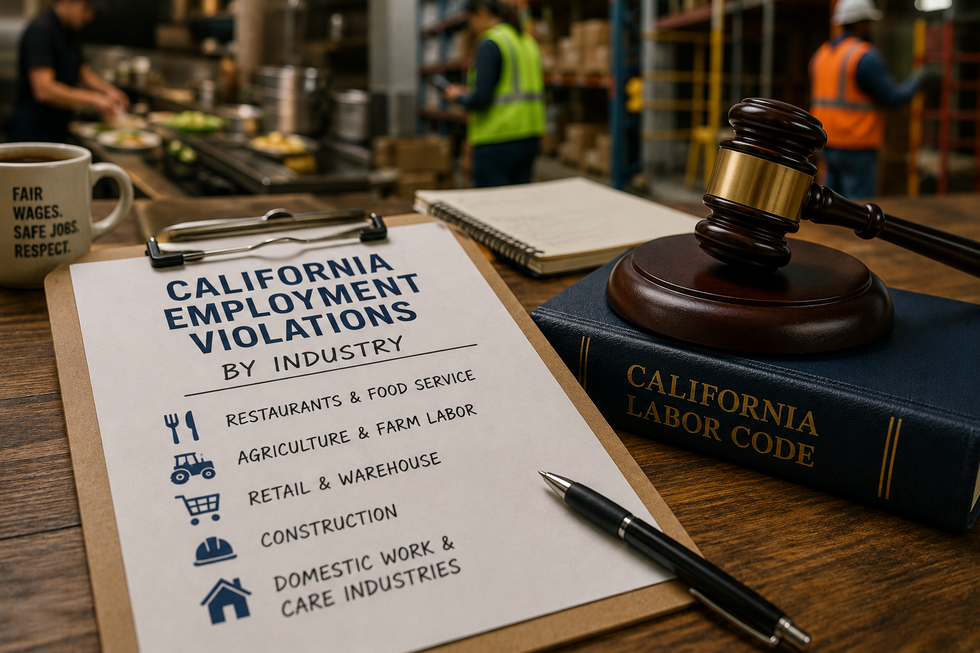
California has some of the most comprehensive and employee-friendly labor laws in the nation. From minimum wage protections to strict meal and rest break requirements, the state sets a high bar for employers. Yet violations remain widespread and they're not evenly distributed. Certain industries are far more prone to specific types of wage theft, safety failures, and discrimination than others. Whether you're a worker trying to understand your rights or an employer striving for compliance, knowing where violations commonly occur is the first step toward accountability.
Table of Contents
- Why California Employment Law Is Different
- Restaurants and Food Service
- Agriculture and Farm Labor
- Retail and Warehouse
- Construction
- Domestic Work and Care Industries
- What Workers Can Do
- The Bottom Line
Why California Employment Law Is Different
Before diving into industry specifics, it's worth understanding what makes California's employment framework unique. The state enforces its own Labor Code, which often provides greater protections than federal law. Key rules include:
- A statewide minimum wage, with higher rates in some cities and industries
- Mandatory 30-minute unpaid meal breaks for shifts over 5 hours, and a second meal break for shifts over 10 hours
- Paid 10-minute rest breaks for every 4 hours worked
- Strict overtime rules: time-and-a-half after 8 hours in a day (not just 40 hours in a week)
- Final paycheck requirements immediate upon termination, within 72 hours for resignation
- Robust anti-retaliation protections for workers who report violations
The California Labor Commissioner's Office and the California Civil Rights Department actively investigate complaints. Still, many violations go unreported especially in industries where workers fear retaliation or don't know their rights.
Restaurants and Food Service
The restaurant industry consistently ranks among the highest for labor violations in California. With a mix of tipped workers, irregular hours, and high turnover, compliance gaps are common.
Most frequent violations:
Tip pooling abuse. California law allows tip pooling among certain non-managerial employees involved in the chain of service including bussers, bartenders, and hosts but employers and managers are prohibited from taking any share of tips. Despite this, tip skimming by management remains a documented problem.
Off-the-clock work. Prep work before a shift, side work after closing, and mandatory pre-shift meetings are all compensable time under California law. Many restaurant workers perform this work without pay.
Missed meal and rest breaks. Fast-paced service environments frequently result in workers not taking legally required breaks. Employers who fail to provide these breaks owe one hour of premium pay per missed break a requirement many are unaware of or simply ignore.
Worker classification disputes. The rise of app-based delivery platforms has created ongoing disputes over worker classification under California law, particularly following AB5 and Proposition 22 litigation. Workers misclassified as independent contractors may be denied minimum wage protections, overtime, and expense reimbursement they are legally owed.
Agriculture and Farm Labor
California's agricultural sector employs hundreds of thousands of workers, many of them undocumented or on temporary visas. This population is particularly vulnerable to exploitation.
Most frequent violations:
Wage theft. Piece-rate pay paying workers per unit harvested rather than by the hour was long used to obscure below-minimum-wage earnings. California law now requires that rest breaks during piece-rate work be paid at a separate hourly rate, but compliance remains inconsistent.
Housing and transportation deductions. Farmworkers who live in employer-provided housing or use employer transportation sometimes have excessive deductions taken from their pay, effectively reducing wages below legal minimums.
Heat illness violations. California's Heat Illness Prevention Standard requires shade, water, rest periods, and emergency procedures for outdoor workers. Violations are unfortunately common during harvest seasons, and have contributed to preventable deaths.
Child labor. Agricultural work has long-standing exemptions in federal law that allow minors to work in fields at younger ages and in more hazardous conditions than other industries. California has moved to close some of these gaps, but enforcement remains a challenge.
Retail and Warehouse
California's retail sector from big-box stores to boutique shops and its massive warehouse and logistics industry face overlapping compliance challenges.
Most frequent violations:
Scheduling ordinance violations. Some California localities have adopted scheduling-related ordinances requiring advance notice of work schedules or premium pay for certain last-minute changes. Retailers operating in those jurisdictions frequently run afoul of these local rules.
Rest break denial in warehouses. Productivity quotas in fulfillment centers have come under fire for discouraging workers from taking legally required rest breaks. California passed AB 701 in 2021 to require transparency in warehouse quota systems, specifically addressing this issue.
Final paycheck delays. High employee turnover in retail means final paycheck violations late issuance or improper deductions are common and costly. Employees may be entitled to waiting time penalties of up to 30 days of wages when employers willfully fail to timely provide final pay.
Expense reimbursement failures. Retail and warehouse workers required to use personal cell phones for work apps or to purchase their own safety equipment are entitled to reimbursement under Labor Code Section 2802. Many aren't paid back.
Construction
Construction is one of the most dangerous industries in California, and labor violations here carry life-or-death consequences beyond the paycheck.
Most frequent violations:
Prevailing wage theft on public projects. California's prevailing wage laws require contractors on public works projects to pay workers at rates set by the Department of Industrial Relations. Underbidding, misclassification of job duties, and false certified payroll records are common methods used to cheat workers out of these higher rates.
Independent contractor misclassification. Construction companies frequently misclassify employees as independent contractors to avoid paying payroll taxes, workers' compensation, and benefits. California's Dynamex decision and AB5 have tightened the rules, but enforcement is ongoing.
Cal/OSHA violations. Fall protection, scaffold safety, trench and excavation requirements, and PPE rules are among the most commonly cited violations by Cal/OSHA in the construction sector. Serious injuries and fatalities remain disproportionately high in this industry.
Domestic Work and Care Industries
Housecleaners, nannies, caregivers, and in-home support workers are covered under California's Domestic Worker Bill of Rights (AB 241), yet remain among the most exploited workers in the state.
Most frequent violations:
Overtime denial. Many personal attendants workers who spend more than 80% of their time supervising, feeding, or dressing a person are entitled to overtime after 9 hours per day or 45 hours per week, though rules vary based on live-in status and other factors. Many employers don't know these rules apply, or choose to ignore them.
No written contracts. California's Wage Theft Protection Act requires employers to provide written notice of pay rates and pay schedules. Domestic workers frequently work under purely verbal arrangements, making wage disputes difficult to resolve.
Rest and sleep time disputes. Live-in domestic workers have specific rules around sleeping time and on-call periods. Misunderstandings and deliberate violations around compensable sleep time are widespread.
What Workers Can Do
If you believe your employer has violated California's labor laws, you have several avenues:
- File a wage claim with the California Labor Commissioner's Office (also called the Division of Labor Standards Enforcement).
- File a retaliation complaint if you've faced adverse action for asserting your rights.
- Consult an employment attorney many employment attorneys take wage theft cases on contingency.
- File a PAGA lawsuit California's Private Attorneys General Act allows workers to sue on behalf of themselves and their coworkers for labor code violations, recovering civil penalties. PAGA claims are subject to procedural requirements and recent legislative reforms, so consulting an attorney is advisable.
The Bottom Line
California's labor protections are only as strong as their enforcement. Across industries, the most common thread in employment violations is the exploitation of workers who feel powerless to speak up whether because of immigration status, economic need, or simple lack of awareness. Knowing your rights is the foundation of exercising them. And for employers, proactive compliance is far less costly than the penalties, class actions, and reputational damage that follow violations. California employers are expected to comply with labor laws regardless of whether violations were intentional and the consequences of non-compliance, from agency investigations to class actions, are rarely worth the risk.


Comments
There are no comments for this post. Be the first and Add your Comment below.
Leave a Comment